Part 1: Mainstream Product Analysis – Don’t Just Focus on “Shiny” and “Flashy”
The “moves” in holographic packaging have long since evolved beyond traditional aluminized films. Depending on the lamination process and application scenario, the following four forms are currently the most popular in the market:
1. Transfer Film (Metallized/Semi-Transfer) – The “Noble Coat” for Paper Packaging
This is often the first choice for high-end cosmetic boxes and premium liquor packaging. The transfer film itself serves merely as a carrier. Using a special adhesive, the holographic pattern (and aluminum layer) is transferred onto the cardboard or paper box, and the original base film is peeled off and recycled.
- Applications: Luxury packaging, premium tea/wine boxes, high-end gift cards.
- Material Advantage: Features a smooth surface with uniform reflection, suitable for subsequent secondary processes like hot stamping and embossing.
2. Transparent Composite Holographic Film – The Future Star of Flexible Packaging
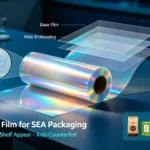
This is currently the fastest-growing category, aligning perfectly with eco-friendly trends. It removes the metallic aluminum layer, creating the holographic microstructure solely on a transparent PET or BOPP base film.
- Applications: Premium pet food bags, frozen fresh food packaging, eco-friendly daily chemical product packaging.
- Material Advantage: Combines holographic effects with high transparency, allowing consumers to clearly see the fresh color of the food inside (e.g., fresh meat, vegetables). More importantly, it eliminates the recycling difficulties associated with aluminum foil, better aligning with single-material recycling trends.
3. Heat-Sealable Composite Film (Aluminized) – The “Eye-Catcher” for Snacks & Tea
This is a finished film made by directly laminating an aluminized holographic layer with an inner heat-sealing layer (such as PE or CPP).
- Applications: Snack bags, coffee/tea packaging, instant beverage pouches.
- Material Advantage: Offers strong shelf appeal, high color saturation, and basic light-blocking barrier properties, with a cost that is moderate compared to transparent holographic film.
4. Holographic Security Labels/Hot Stamping Foil – The “Last Line of Defense” for Brand Safety
Mostly used for sealing stickers or bottle labels on pharmaceuticals, premium spirits, and cosmetics.
- Applications: Regulatory authority certified products, anti-counterfeiting seals for high-end liquor, cosmetic tube seals.
- Material Advantage: When combined with lithography technology, it can incorporate unique serial numbers, QR codes, or optically variable devices (OVD), making counterfeiting extremely costly.
Part 2: Midstream Processing Pain Points – “Traps” and Solutions in Lamination and Printing
No matter how beautiful a holographic film is, it’s all for naught if it cannot be perfectly combined with other layers of the pouch or if high-quality graphics cannot be printed on it. Based on our extensive cooperation with various converters, the following three processing pain points are the most common:
Pain Point 1: Poor Ink Adhesion Leading to “Peeling” After Lamination
The surface of holographic film undergoes strict microstructure embossing and vacuum metallization, resulting in an extremely low surface energy (low wetting tension), making it difficult for standard inks to adhere firmly.
Solution: We strongly recommend that customers perform corona treatment before printing, or incorporate a high surface-energy primer coating into the film formulation. When supplying holographic film, we also recommend specialized primer formulations based on the customer’s specific printing press type.
Pain Point 2: The “Century-Old Problem” of Adhesive and Holographic Effects
During flexible packaging lamination, adhesives need to be applied. If solvent-based adhesives are applied too heavily, or if solvent residues are too high, they can corrode or swell the holographic micro-structure surface, causing the holographic pattern to darken or lose its luster.
Solution: Adopting solvent-free lamination processes is one of the key trends. If solvent-based adhesives are unavoidable, it is crucial to strictly control the coating weight (lower than conventional standards) and ensure sufficient curing time to avoid “physical damage” to the holographic structure from solvent residue.
Pain Point 3: Insufficient Heat Seal Strength
The outer layer of holographic film is usually PET, while the inner layer is the heat-seal layer (like PE). If the lamination bond strength is insufficient, the outer holographic layer will delaminate from the inner layer during bag-making heat sealing, leading to “bag breakage” or “separation” at the seal.
Solution: This tests not only the adhesive performance but also the metallization adhesion strength on the holographic film surface. High-end holographic films use special “primer” layers during the vacuum metallization stage to solidify the aluminum layer, ensuring the peel strength meets the required standards.
Part 3: Downstream Procurement Guide for Holographic Packaging Films
As a brand owner or purchaser, don’t just ask “How much per kilogram?” when inquiring about holographic packaging films. To improve efficiency, we suggest you clarify the following five parameters:
- Width & Thickness: Must align with your specific bag-making and printing machine specifications.
- Visual Requirements (“Brightness” vs. “Depth”): Do you need a mirror-like high reflectivity, or a more subdued stereoscopic effect? This depends on the depth of the laser embossing and the thickness of the metal coating.
- Transparency Requirements: Do you need to see the product through the film (choose transparent holographic film), or do you need full opacity (choose aluminized holographic film)?
- Functional Stacking: Do you need a heat-seal layer with specific temperature parameters? Does it need to integrate with anti-counterfeiting code printing?
- Environmental Compliance: Is your product intended for export to the EU? You must ensure the adhesives, coatings, and aluminum layers in the holographic film comply with US FDA and EU EU10/2011 food contact material standards.
Conclusion: Making Holographic Film More Than Just “Face Value”
Holographic packaging film is one of the most impactful elements in today’s consumer goods market. However, for a forward-thinking packaging solution provider, our responsibility isn’t just to provide a dazzling appearance; it’s to ensure that this “face” can be firmly and perfectly integrated with the “substance” of the packaging.
At FlexFilm, every roll of holographic film we supply undergoes strict peel strength tests, medium resistance tests, and heat-seal strength tests.
Are you looking for the perfect holographic packaging solution for your premium products?
Whether you need small batch prototyping or large-scale mass production, feel free to Contact us todayWe provide the most professional material selection advice.