Holographic Film Is Not Just ‘Pretty’: 5 Main Structures & Their Real‑World Applications
Walk into any convenience store in Bangkok, Jakarta or Ho Chi Minh City: shiny, rainbow‑coloured packaging catches your eye. But for a packaging buyer or brand owner, that holographic effect is never just decoration — it’s a functional layer that fights counterfeiting, boosts shelf appeal, and often determines whether your product stands out in a crowded ASEAN market.
Yet many buyers treat “holographic film” as a single product. In reality, the structure behind the shimmer varies dramatically — and choosing the wrong substrate or coating can lead to dulled effects, delamination, or even compliance headaches in tropical climates.
This guide breaks down 5 common holographic film structures, what they’re actually made of, and — most importantly — which real packaging applications each one fits best, with a practical view for Southeast Asian brands and converters.
Why Structure Matters More Than the Shine
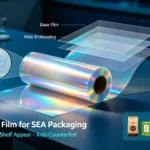
A holographic effect is created by micro‑embossing or cast‑curing a diffraction pattern onto a polymer film, then often coating it with a reflective layer (usually aluminium) and a protective topcoat. Two common patterning methods are thermal embossing and cast‑curing; cast holograms generally deliver finer, sharper diffraction effects. The base film (PET, BOPP, PA, or PE) and the way layers are combined determine durability, printability, barrier properties, and cost.
In Southeast Asia’s heat and humidity, these structural choices are even more critical. High UV exposure, monsoon‑level moisture, and varying cold‑chain conditions mean that a film that works perfectly in a temperate climate can fail within weeks in the tropics.
5 Holographic Film Structures at a Glance
| Structure | Typical Composition | Key Property | Best Suited For |
|---|---|---|---|
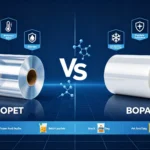
| PET‑based holographic | PET / embossing varnish / Al metallization / protective topcoat | High stiffness, excellent print adhesion | Premium cosmetics, electronics, luxury dry food |
| BOPP holographic | BOPP / embossed layer / metallization / optional topcoat (Selected grades support hot‑stamp transfer) |
Cost‑effective, good flexibility, high‑speed machinability | Snack foods, confectionery, cigarette cartons |
| Heavy‑metallized holographic | Base film + heavy‑deposit Al reflective layer + holographic embossing | Mirror‑like high reflectivity, strong visual depth | Luxury liquor boxes, high‑end tea, gift packaging |
| Transparent holographic (non‑metallized) | Clear PET/BOPP with refractive diffraction pattern (no aluminium layer) | Clear translucent effect, no metal opacity | Windowed pouches, premium fresh produce, see‑through packaging |
| Laminated holographic (multi‑layer) | Holo film laminated to PE/PA/foil (e.g., PET/PE, PET/AL/PE) | Combines optics with barrier & bone‑poke resistance | Frozen meat, seafood, pharmaceutical blister packs |
Real Applications: Where Each Structure Actually Shines
The table above gives a quick reference, but let’s put these structures into real packaging scenarios — especially those relevant to Southeast Asian markets like Indonesia, Thailand, Vietnam, Malaysia and the Philippines.
Snack & Confectionery — BOPP Holographic
BOPP offers low cost and good machinability for high‑speed wrapping. Used for candy sticks, biscuit pouches, and promotional seasonal packs. Its flexibility makes it ideal for horizontal form‑fill‑seal (HFFS) lines commonly used in Southeast Asian snack factories.
Premium Personal Care — PET Holographic
PET’s high stiffness and excellent printability make it ideal for shampoo sachets, face mask packs, and luxury soap boxes sold in department stores across Kuala Lumpur and Singapore. The material holds fine registration for high‑end gravure printing.
Frozen Meat & Seafood — Laminated Holographic
Holo film laminated with PA or PE provides bone‑poke resistance while adding brand security. Used for premium frozen tuna and shrimp export packs from Vietnam and Thailand. The PA layer stops sharp bones from piercing the pack during frozen storage and transport.
Pharmaceutical / OTC — Laminated & Transparent
Transparent non‑metallized holographic on blister lidding delivers visual anti‑counterfeiting features without obscuring the product; physical tamper‑evident performance comes from coating design. Meanwhile laminated versions offer moisture barrier — critical for markets like Indonesia and the Philippines where humidity is high year‑round.
High‑End Tea & Coffee — Heavy‑metallized Holographic
Aluminium heavy‑deposit metallization gives a premium metallic sheen that elevates gift packaging for Vietnamese coffee or Thai premium teas. The reflective surface also provides basic oxygen barrier, extending shelf life for roasted beans.
Electronics Accessories — PET / BOPP Holographic
Used for phone case packaging, USB cable hang‑cards, and anti‑counterfeit labels for chargers and earphones. The holographic effect doubles as a brand authentication feature, which is increasingly important in Southeast Asian e‑commerce channels.
Behind the Structure: Process & Coating Matter
A common misconception: “all holographic films are the same.” The reality is that embossing temperature, protective coating, and surface treatment vary dramatically between suppliers — and those variables make the difference between a film that lasts 12 months and one that delaminates in 7 days.
- Hot‑stamping grade BOPP holographic film requires precise temperature control (104–110 °C) during embossing; otherwise, the optical effect degrades and the diffraction pattern becomes dull.
- UV protection is critical for PET‑based films in Southeast Asia — prolonged sunlight can yellow the adhesive or oxidize the aluminium layer, turning the rainbow effect into a cloudy grey.
- Corona treatment improves ink anchorage, especially important when printing fine details or QR codes on the holographic surface. Without it, inks may scratch off during handling.
- Slip‑agent migration accelerates in high heat; this can affect machinability on vertical form‑fill‑seal (VFFS) lines. A well‑formulated topcoat prevents this and ensures consistent running speeds.
Southeast Asia Special: Humidity Is the Real Test
In countries like Indonesia and Thailand, where average relative humidity exceeds 80% for most of the year, PA‑containing holographic laminates absorb ambient moisture and suffer degraded oxygen‑barrier performance under high humidity — while PET‑based structures are more dimensionally stable but need added UV coating.
Always ask your supplier for “tropicalized” structural data, not just standard lab results at 23 °C / 50% RH. Real‑world performance in a Bangkok warehouse or a Jakarta distribution centre is what ultimately matters for your brand.
Quick Selection Guide for Buyers
Use this rule‑of‑thumb when evaluating holographic film for your next project:
- Need high stiffness + premium print? → Choose PET‑based holographic.
- Cost‑sensitive high‑volume snacks? → Choose BOPP‑based holographic.
- Frozen meat / puncture risk? → Choose laminated structure with PA or enhanced PE.
- Clear, minimal “plastic look” packaging? → Choose transparent holographic (non‑metallized).
- Luxury, gift, or anti‑counterfeit priority? → Choose heavy‑metallized holographic with extra topcoat.
Conclusion
Holographic film is a strategic packaging material — not a decorative afterthought. The right structure protects your brand, enhances consumer trust, and can even reduce returns due to package failure in humid climates.
Whether you are a brand in Jakarta developing a new premium coffee line, or a converter in Bangkok looking to expand your holographic portfolio, understanding these five structures is your first step toward making a technically sound, cost‑effective choice.
Request a tropicalized holographic film sample — PET / BOPP / laminated options, tested for Southeast Asian climates. We provide tropical‑condition accelerated ageing test reports upon request. Contact our technical team for a free structure consultation.
© 2026 Holographic Film Expert · B2B technical resource for packaging professionals
Message us for more information