Price is Not a Reason to Choose – Performance Gaps Are
When BOPET and BOPA both appear on the procurement list, most buyers instinctively compare prices. But as a film manufacturer serving packaging plants in over 50 countries, we have seen too many costly after-sales issues caused by “saving a few cents per kilo” – insufficient heat seal strength leading to leakers, poor puncture resistance causing transit damage, moisture absorption distorting print registration…… These hidden costs often far exceed the film price difference.
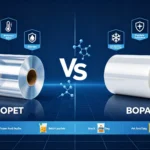
BOPET (biaxially oriented polyester) and BOPA (biaxially oriented polyamide) are both high-performance core substrates for flexible packaging, but their “performance DNA” is completely different. This article breaks down the real differences across seven technical dimensions: molecular structure & basic properties, mechanical durability, barrier performance, printability & converting, temperature tolerance, cost structure, and recyclability – followed by a scenario-based decision matrix and FAQs. There is no absolute “better” – only “better suited.”
1. Basic Properties: Two Films, Two Personalities
Before diving into data, build an intuitive picture: BOPET is “rigid, stiff, and highly transparent,” while BOPA is “flexible, puncture-resistant, and stretchable.” This difference comes from their polymer backbone – PET contains rigid benzene rings that give high modulus and dimensional stability; PA’s amide bonds provide excellent flexibility and hydrogen-bond crosslinking, retaining toughness even at low temperatures.
| Property | BOPET (12 µm) | BOPA (15 µm) | Key interpretation |
|---|---|---|---|
| Density (g/cm³) | 1.39 | 1.14 | BOPA is lighter – less material per area |
| Tensile strength MD/TD (MPa) | ≥200 / ≥200 | ≥220 / ≥200 | Comparable, BOPA slightly higher |
| Elongation at break MD/TD (%) | 80~120 / 80~120 | ≥300 / ≥300 | BOPA elongation is ~3× BOPET – superior impact resistance |
| Tensile modulus (MPa) | ≈4500 | ≈1800 | BOPET is stiff; BOPA is supple |
| Oxygen transmission (cm³/(m²·24h·atm)) | 50~80 | 30~50 | BOPA has better O₂ barrier (dry state) |
| Water vapour transmission (g/(m²·24h)) | 20~30 | 100~200 | BOPA is highly moisture-sensitive – WVTR is 5–10× higher |
| Continuous service temperature | 120~150°C | 80~100°C | BOPET withstands retort/hot-fill; BOPA does not |
| Brittle temperature | ≈ -30°C | ≈ -60°C | BOPA excels in deep-freeze applications |
The numbers tell the story: BOPET leads in moisture barrier, heat resistance and stiffness, while BOPA dominates puncture resistance, flexibility and low-temperature toughness. Every subsequent chapter explores these “personality” differences in depth.
2. Mechanical & Durability: Puncture, Drop, Flex-crack
This is BOPA’s strongest territory. In vacuum-packed meat, frozen seafood, nuts, and any application where sharp edges threaten the package, BOPA is almost the default answer.
- Puncture resistance: BOPA typically outperforms same-thickness BOPET by 50–80%. For chicken bones, fish fins, or hard-shell nuts, BOPA effectively prevents pinhole leaks.
- Drop resistance: BOPA’s high elongation absorbs impact energy without cracking. BOPET, being stiffer, is more prone to brittle fracture under sharp impacts.
- Flex-crack / folding endurance: Under repeated bending or vibration during transport, BOPA shows much better fatigue resistance than BOPET. If your package is handled frequently or shipped over long distances, BOPA reduces stress-whitening and cracks.
3. Barrier Performance: Oxygen vs Water Vapour – You Can’t Have Both
This dimension is often misunderstood. Many buyers think “BOPA has better oxygen barrier, so it must be the superior barrier film” – while ignoring its glaring weakness in moisture protection.
- Oxygen barrier (O₂TR): In dry state, BOPA is indeed better than BOPET, especially for maintaining red colour in fresh meat. However, BOPA’s O₂ barrier drops significantly as humidity increases (amide bonds absorb moisture and expand free volume). In humid environments or high-moisture contents, this advantage may disappear.
- Water vapour barrier (WVTR): BOPA’s WVTR is 5–10 times higher than BOPET – it is practically a moisture “pass-through.” If you pack dry foods (biscuits, milk powder, pet dry food), BOPA must be laminated with EVOH, PVDC, or aluminium foil, otherwise the product will quickly gain moisture.
- Practical solutions: In real applications, BOPA is often used as a middle layer with PE, CPP, or BOPET to form an “oxygen barrier + moisture barrier” composite. BOPET, with its excellent WVTR, is more economical as an outer or middle layer for dry-goods packaging.
4. Printing & Converting: Dimensional Stability, Registration, Surface Energy
In high-speed printing and lamination, dimensional stability directly determines yield and appearance quality.
- Heat shrinkage: BOPET shrinks ≤2% at 150°C, while BOPA may reach 3–5% at just 100°C. This means BOPA is more prone to distortion during drying or thermal lamination, leading to misregistration and pattern warping. BOPET is the preferred choice for high-precision printing, especially for multicolour registration and fine lines.
- Surface tension / wettability: Both can be corona-treated to 40–44 dyn/cm, but BOPA’s higher polarity generally provides better adhesion for inks and adhesives. However, BOPA’s surface energy decreases after moisture absorption – storage humidity matters.
- Static & slip: BOPET tends to build up static charge; anti-statics are often needed for high-speed bag-making. BOPA is more forgiving, but slip-agent migration may affect heat-seal strength.
Field experience: If you run 10-colour gravure presses and require extreme precision (e.g., cosmetics, personal care), BOPET delivers more stable registration. For smaller-batch, flexible-printing operations, BOPA offers higher tolerance.
5. Temperature Tolerance: Retort, Freezing, Tropical Warehousing
Temperature is where BOPET and BOPA diverge most sharply – and where wrong choices hurt the most.
- High-temperature end (retort / sterilisation): BOPET withstands 121°C retort (30 min) and short-term 150°C hot-fill. BOPA softens and shrinks significantly above 100°C, especially when moisture-absorbed. For any high-temperature process (retort pouches, ready-meals), BOPET is mandatory – or BOPA must be laminated with heat-resistant layers, but pure BOPA is not suitable as the main retort layer.
- Low-temperature end (freezing / chilling): BOPA’s low-temperature toughness is unrivalled – it retains impact resistance at -40°C, making it the standard for frozen seafood, ice cream, and dumplings. BOPET becomes brittle below -20°C and is prone to cracking under impact.
- Hot & humid environments (e.g., Southeast Asia, South America): BOPA absorbs moisture and swells, causing delamination and wrinkling in laminates. BOPET is virtually unaffected by humidity. If you export to tropical regions and the package is not hermetically sealed, BOPET as the outer layer is a safer bet.
6. Cost Structure: Price per Kg ≠ Cost per Package
This is the core of “don’t just look at price.” BOPA’s per-kg price is typically 20–40% higher than BOPET, but the per-package cost difference is often overestimated.
- Density difference: BOPA (1.14) is less dense than BOPET (1.39). At the same thickness and area, BOPA uses less weight. When priced per square metre, BOPA’s price disadvantage is partly offset.
- Thickness design: BOPA is often used at 15 µm, while BOPET can be used at 12 µm for similar strength. But if puncture resistance is needed, BOPET must be thickened to 20 µm or more – at which point the cost advantage diminishes.
- Hidden losses: BOPA requires stricter storage (temperature- and humidity-controlled) to avoid scrap; BOPET is humidity-insensitive, so warehousing costs are lower. Additionally, waste from misregistration due to BOPA shrinkage during printing is a hidden cost.
Recommendation: Perform a total-cost-of-ownership (TCO) calculation that includes material, processing waste, transit breakage, and customer complaint handling. In many cases, switching to BOPA for frozen meat increased film cost by 12% but reduced return-rate from 3.2% to 0.5% – net profit improved significantly.
7. Environmental & Recyclability: Mono-material Trends
With EU PPWR and the global circular economy, “design for recyclability” is increasingly important. BOPET and BOPA follow different paths here.
- Mono-material feasibility: BOPET laminated with PE is still multi-material and hard to recycle; BOPA with PE is even less compatible. The current industry focus is on MDO-PE or CPP mono-structures to replace traditional laminates, but BOPET and BOPA will remain as functional layers for the foreseeable future.
- Chemical recycling potential: BOPET depolymerisation (BHET route) is relatively mature, allowing recycled monomers to be re-polymerised. BOPA’s recycling route is more complex. From an ESG perspective, BOPET scores slightly higher in recyclability design guides.
- Down-gauging: BOPA can be further stretched to 10 µm while retaining good performance, reducing resin usage and carbon footprint. BOPET has less down-gauging room (too thin loses stiffness).
Trend view: Both will be used in the short term. Long-term, BOPET has a slight edge in recyclability, while BOPA may benefit from bio-based nylon or chemical recycling. We recommend keeping mono-material options on your radar for future readiness.
8. Selection Decision Matrix: Find the “Best Fit” for Your Application
No single film fits all – only matched scenarios. The table below provides recommended preferences (★ = stronger recommendation).
| Application / Typical package | Preferred substrate | Rationale (brief) |
|---|---|---|
| Frozen meat (bone-in) | BOPA ★★★★★ | Puncture resistance, low-temp toughness, drop |
| Frozen seafood (fish/shrimp) | BOPA ★★★★★ | Withstands sharp edges, flexible |
| Retort ready-meals (pouches) | BOPET ★★★★★ | Heat resistance, dimensional stability |
| Pet dry food (large bags) | BOPET ★★★★☆ | Moisture barrier, stiffness, print quality |
| Pet wet food / can lids | BOPA ★★★★☆ | Puncture, high seal strength |
| Biscuits / snacks (moisture-critical) | BOPET ★★★★★ | Excellent WVTR, cost-effective |
| Coffee / tea (high oxygen barrier) | BOPA + EVOH laminate ★★★★ | Pure BOPA lacks moisture barrier – needs lamination |
| Personal care / laundry pods | BOPET ★★★★ | High clarity, chemical resistance |
| Ice cream (outer wrap) | BOPA ★★★★ | Cold-flex, but requires moisture-barrier coating |
Special note: Many high-end applications use “BOPET/BOPA composites” – e.g., BOPA as the middle layer for puncture resistance, BOPET as the outer layer for stiffness and heat resistance, plus a PE sealant layer. This “complementary” design often delivers the best balance of performance and cost.
9. Common Myths & FAQs (from procurement and engineers)
- ❓ Myth 1: “BOPA is more eco-friendly than BOPET because it’s bio-based.”
- —— Conventional BOPA is not bio-based; most commercial polyamide comes from petrochemical routes. Bio-based PA is still in its infancy and very expensive. Environmental impact must consider production energy and recyclability – not a blanket statement.
- ❓ Myth 2: “BOPET is clearer, so premium packaging always uses BOPET.”
- —— Both achieve >90% transparency – visual difference is negligible. Premium brands choose BOPET more for its stiffness and gloss, not clarity per se.
- ❓ Myth 3: “Since BOPA has better O₂ barrier, it must be the best for vacuum packaging.”
- —— Oxygen barrier is important, but moisture barrier is equally critical. If meat exudes water, BOPA absorbs it, loses O₂ barrier, and shelf-life shortens. Lamination with EVOH or aluminium foil is often required.
- ❓ Myth 4: “BOPA is softer, so it seals better in bag-making.”
- —— Heat-seal performance depends on the sealant layer (PE or CPP), not the outer BOPA/BOPET. However, BOPA’s slip properties affect film handling during conversion.
10. Conclusion: Don’t Let “Rule of Thumb” Make the Decision
BOPET and BOPA are both excellent substrates, but they serve different roles – like “plate armour” vs “chainmail.” One is rigid and cut-resistant; the other is flexible and puncture-proof. Neither can dominate every battlefield.
Three practical recommendations:
- Run lab simulations: Before bulk purchase, test small batches with your actual product, shipping conditions, and storage environment – measure drop, freeze-thaw, and seal strength. Real data beats theory.
- Engage deeply with your supplier: A quality film manufacturer (like us) can provide customised formulations – anti-static BOPET, high-slip BOPA, anti-fog coatings – that mitigate inherent weaknesses.
- Think in “composite structures,” not single substrates: Most flexible packaging is multi-layer. You can combine BOPET and BOPA to leverage each other’s strengths. We specialise in designing “functional layer stacks” that balance performance and cost.