Silage Film UV Stabilization: How Carbon Black & HALS Extend Outdoor Service Life
So how does silage film survive a year or more in the field while maintaining its airtight seal, puncture resistance, and stretch performance? The answer lies in two critical UV stabilization systems: carbon black pigment and Hindered Amine Light Stabilizers (HALS). This article breaks down the science behind each mechanism, how they work together, and what film buyers should look for when evaluating silage film quality for different climate zones.
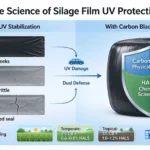
Carbon black physically blocks UV radiation from penetrating the film, while HALS chemically neutralize the free radicals that cause polymer degradation. Used in combination, they deliver 10–20x longer outdoor service life than unstabilized PE film.
1. The UV Degradation Problem: What Happens to Unprotected PE Film
Before understanding how UV stabilizers work, it is essential to understand what they are protecting against. Polyethylene (PE), the base resin for silage film, is a long-chain hydrocarbon polymer. When exposed to ultraviolet radiation — particularly UV-B (280–315 nm) and UV-A (315–400 nm) wavelengths — the following chain of degradation events occurs:
| UV radiation hits film surface |
→ | Polymer bonds break (chain scission) |
→ | Free radicals formed & multiply |
→ | Embrittlement, cracking & failure |
The mechanism unfolds in four stages:
1.1 UV Photon Absorption
UV photons carry sufficient energy to break C–H and C–C bonds in the polyethylene backbone. The solar UV energy at sea level can reach approximately 3,000–4,000 MJ/m² per year in tropical and subtropical regions — a massive energy input that the polymer simply cannot absorb without damage.
1.2 Chain Scission & Radical Formation
When a UV photon breaks a polymer bond, it creates a free radical — an unstable molecular fragment with an unpaired electron. This radical is highly reactive and immediately attacks neighboring polymer chains, creating new radicals in a chain reaction. One UV photon can ultimately cause hundreds of bond breaks through this cascade effect.
1.3 Auto-Oxidation Cycle
In the presence of atmospheric oxygen, free radicals react with O₂ to form peroxide radicals, which then attack more polymer chains. This auto-oxidation cycle accelerates degradation exponentially — the process feeds itself. Even after the sun sets, the radical chain reaction continues within the polymer matrix.
1.4 Physical Manifestation: Embrittlement & Cracking
As chain scission reduces molecular weight, the film loses elongation, tensile strength, and flexibility. Within 2–6 months of unprotected outdoor exposure, the film becomes brittle, develops micro-cracks, and the airtight silage seal is compromised. Oxygen infiltrates the silage mass, triggering aerobic spoilage that can destroy the entire bale.
On a typical summer day in a temperate agricultural region (e.g., 40° latitude), silage film receives the equivalent of 20–30 MED (Minimal Erythemal Doses) of UV radiation per day. Over a 12-month storage period, that translates to thousands of cumulative UV exposure hours — an environment that will destroy unstabilized PE film in a matter of weeks, not months.
2. Carbon Black: The Physical UV Barrier
Carbon black is the oldest, most effective, and most economical UV stabilizer used in agricultural films. It works through a fundamentally different mechanism than HALS — physical absorption rather than chemical scavenging.
2.1 How Carbon Black Works
Carbon black is an amorphous carbon material with an extremely fine particle size (typically 15–75 nm) and a massive surface area. When dispersed uniformly within the polyethylene matrix, carbon black particles act as internal UV absorbers:
- UV absorption: Carbon black absorbs UV radiation across the entire UV spectrum (UV-B, UV-A, and even visible light), converting UV energy into harmless thermal energy (heat) that dissipates through the film.
- Physical blocking: The fine carbon particles create a physical barrier that prevents UV photons from penetrating deep into the film thickness, protecting the inner polymer layers even when the outer surface is under continuous irradiation.
- Radical scavenging (secondary): The large surface area of carbon black particles also provides free radical trapping sites, offering a secondary chemical stabilization effect.
The result is straightforward: UV photons never reach the polymer chains. If the radiation cannot be absorbed by the polymer, the degradation cascade cannot begin.
2.2 Carbon Black Loading & Film Performance
The concentration of carbon black in the film directly determines its UV blocking efficiency. However, higher loading is not always better — excessive carbon black degrades film mechanical properties and increases material costs.
| Carbon black loading (wt%) | UV blocking efficiency | Film mechanical impact | Typical application |
|---|---|---|---|
| 0.5–1.0% | Moderate (60–70% UV absorbed) | Negligible | Short-term cover film (3–6 months) |
| 1.5–2.5% | High (85–92% UV absorbed) | Slight elongation decrease | Standard silage film (12 months) |
| 2.5–3.5% | Very high (95–97% UV absorbed) | Noticeable stiffness increase | Tropical / high-UV silage film (12–18 months) |
| > 4.0% | Maximum (>98% UV absorbed) | Significant — reduced elongation & cling | Industrial/multipurpose — not recommended for silage |
2.3 Why Not Just Use More Carbon Black?
Carbon black loading above 3.5% creates several problems for silage film specifically:
- Reduced film elongation & stretchability: Silage film relies on high elongation (typically 150–250%) to achieve tight bale wrapping. Excess carbon black stiffens the polymer, reducing stretch performance and wrap conformability.
- Weakened self-adhesive cling: The tacky cling layer that seals bale overlaps is negatively affected by high carbon loading, potentially creating gaps in the airtight seal.
- Puncture resistance trade-off: While moderate carbon black improves puncture resistance slightly, overloading creates stress concentration points that can actually reduce tear propagation resistance.
- Cost inefficiency: Beyond 3% loading, the marginal UV protection benefit drops sharply while material costs rise linearly.
This is precisely why HALS is added as a complementary system — to extend service life beyond what carbon black alone can achieve, without degrading mechanical properties.
3. HALS: The Chemical Radical Scavenger
Hindered Amine Light Stabilizers (HALS) represent the most significant advancement in polymer UV protection since carbon black. Unlike carbon black, which blocks UV physically, HALS works at the molecular level to interrupt the degradation chain reaction after it has already begun.
3.1 The Denisov Cycle: How HALS Regenerates Itself
The brilliance of HALS lies in its regenerative mechanism, known as the Denisov Cycle. Unlike UV absorbers that are consumed over time, HALS continuously regenerates its active stabilizing species, providing long-lasting protection with relatively low additive concentrations.
| HALS (amine form) N-H |
→ | Reacts with peroxide radical |
→ | Forms stable nitroxyl radical (N-O·) |
→ | N-O· traps new polymer radical |
→ | Regenerates back to N-O· |
↺ |
Here is what happens step by step:
- Initial activation: The HALS amine (N-H) reacts with a peroxide radical formed during UV degradation, producing a stable nitroxyl radical (N-O·).
- Radical trapping: The nitroxyl radical (N-O·) encounters a polymer alkyl radical (R·) and captures it, forming an alkoxyamine (N-O-R).
- Regeneration: The alkoxyamine reacts with another peroxide radical, releasing a stable ketone/alcohol product and regenerating the nitroxyl radical (N-O·) back into its active form.
- Continuous cycle: Each HALS molecule can repeat this cycle hundreds to thousands of times, neutralizing radical after radical without being consumed.
This regenerative mechanism is why HALS is so effective at low concentrations (typically 0.3–1.5 wt%) and why it provides protection far longer than traditional UV absorbers that deplete over time.
A conventional UV absorber (like benzophenone or benzotriazole) blocks UV radiation but is gradually consumed through photolysis. HALS does not absorb UV at all — it neutralizes the damage products. This means HALS remains effective even after carbon black has already absorbed most of the UV. The two systems work at different stages of the degradation cascade, making them highly complementary.
3.2 HALS Grades Relevant to Silage Film
Not all HALS are created equal. Different HALS chemistries offer different performance profiles depending on the application, climate, and co-additive package. The table below summarizes the most relevant grades for agricultural film:
| HALS type | Molecular weight | Key characteristics | Best suited for |
|---|---|---|---|
| Low MW HALS (e.g., HALS-770) |
~480 g/mol | Fast radical scavenging; high mobility in polymer; but may migrate/volatile | Short-term films; cost-sensitive applications |
| High MW HALS (e.g., HALS-944) |
~2,800 g/mol | Excellent longevity; low migration; compatible with carbon black; durable | Long-term silage film (12+ months) — recommended |
| Oligomeric HALS (e.g., HALS-622) |
~3,500 g/mol | Maximum permanence; minimal extraction; good thermal stability | Tropical/high-temperature silage; multi-season films |
| NOR HALS (N-alkyl modified) |
Varies | Activated form — does not require peroxide to form nitroxyl; instant protection | Pesticide-containing films; acid contact environments |
For silage film applications, high molecular weight HALS (HALS-944 or equivalent) is the industry standard recommendation. Its low migration rate ensures the stabilizer remains within the polymer matrix throughout the full 12–18 month storage cycle, and its compatibility with carbon black makes it ideal for the typical black silage film formulation.
4. The Synergistic Effect: Carbon Black + HALS Working Together
The real magic of modern silage film UV stabilization is not in either additive alone — it is in the synergistic combination of carbon black and HALS. Understanding this synergy explains why high-quality silage film uses both, even though each could theoretically work independently.
4.1 Division of Labor
The two stabilizers operate at different stages of the UV degradation cascade, creating a multi-layer defense:
| Stage | What happens | Which stabilizer acts |
|---|---|---|
| 1. UV photon enters film | UV radiation penetrates polymer surface | Carbon black — absorbs & blocks ~95% of UV |
| 2. Residual UV reaches polymer | The ~5% UV that penetrates carbon black barrier breaks bonds | Carbon black traps some radicals on its surface |
| 3. Free radicals formed | Chain reaction begins; radicals multiply via auto-oxidation | HALS — scavenges radicals via Denisov Cycle |
| 4. Radicals propagate | Without intervention, cascade would destroy polymer chains | HALS — continuously regenerates & neutralizes |
| 5. Long-term aging | Months of cumulative UV exposure; stabilizer depletion | HALS — regenerative cycle sustains protection |
4.2 Quantified Synergy: Service Life Comparison
The performance difference between carbon black alone, HALS alone, and the combination is dramatic. The data below is based on typical agricultural film accelerated weathering tests (ASTM G154, UV-B fluorescent lamps, 340 nm, irradiance 0.89 W/m², cycle: 8h UV / 4h condensation at 50°C):
| Stabilizer system | Time to 50% elongation retention (hours) | Estimated outdoor service life* | Relative performance |
|---|---|---|---|
| None (unstabilized PE) | ~400 hours | 2–4 weeks | 1x (baseline) |
| Carbon black only (2.5%) | ~3,000 hours | 8–10 months | ~7x |
| HALS only (0.8%, no carbon black) | ~4,500 hours | 10–12 months | ~11x |
| Carbon black (2.5%) + HALS (0.8%) | ~8,000+ hours | 18–24 months | ~20x |
*Estimated outdoor service life based on accelerated test correlation factors. Actual field life varies with geographic UV intensity, film thickness, and installation conditions.
Carbon black alone blocks UV but cannot stop the 5% that penetrates — radicals accumulate over months and eventually cause failure. HALS alone is excellent at scavenging radicals, but in a transparent film, the massive UV load overwhelms its capacity. Together: carbon black reduces the radical formation rate to a level HALS can easily manage, and HALS neutralizes the residual radicals carbon black cannot block. The result is protection that exceeds the sum of either system alone by roughly 2–3x.
5. Environmental Factors That Affect Stabilizer Performance
UV stabilizer effectiveness is not a fixed number — it varies significantly depending on where and how the silage film is used. The following environmental factors can accelerate or decelerate stabilizer depletion:
5.1 Geographic UV Intensity
Solar UV radiation varies dramatically by latitude, altitude, and local atmospheric conditions. The same silage film will perform very differently in different regions:
| Region / latitude | Annual UV dose (MJ/m²) | Relative UV intensity | Recommended film spec |
|---|---|---|---|
| Tropical (0–23°, e.g., Indonesia, Thailand) | 3,500–4,500 | Very high | Carbon black 3% + HALS 1.2% + thicker film (30μm+) |
| Subtropical (23–35°, e.g., South China, Middle East) | 2,800–3,500 | High | Carbon black 2.5% + HALS 0.8–1.0% |
| Temperate (35–55°, e.g., Europe, North America) | 2,000–2,800 | Moderate | Carbon black 2% + HALS 0.6–0.8% |
| High altitude (>1000m, any latitude) | +15–25% vs sea level | Elevated | Increase HALS loading by 20–30% |
5.2 Temperature & Thermal Cycling
High temperatures accelerate both UV degradation and stabilizer consumption. The Arrhenius relationship means that every 10°C increase in polymer temperature roughly doubles the degradation rate. Dark-colored silage film (especially carbon black-loaded film) absorbs solar heat and can reach surface temperatures of 50–70°C on a sunny day, even when ambient air temperature is only 25–30°C.
This thermal effect is why tropical regions require higher stabilizer loading — not just because of higher UV, but because the film runs hotter, accelerating both degradation and additive migration/volatilization.
5.3 Pesticide & Agrochemical Contact
This is a frequently overlooked factor. Many pesticides, herbicides, and fungicides contain halogen-based compounds (chlorine, bromine) or sulfur-containing active ingredients. When these chemicals contact silage film — through spray drift, residual contamination on forage, or direct application — they can deactivate HALS by converting the amine group into inactive salts.
If the silage film will be used in environments with significant agrochemical exposure, consider:
- NOR HALS grades (N-alkyl modified), which are resistant to pesticide deactivation
- Higher HALS loading to compensate for partial deactivation
- Thicker film to provide a deeper stabilizer reservoir
5.4 Film Thickness
Thicker film provides a larger volume of stabilizer per unit surface area. A 25μm film and a 50μm film with the same stabilizer concentration (wt%) will have different service lives because the thicker film contains twice the total amount of stabilizer per square meter. For long-term tropical applications, specifying a minimum film thickness of 25–30μm is essential to ensure adequate stabilizer reserves.
6. How to Evaluate Silage Film UV Stabilization Quality
For agricultural distributors, farming cooperatives, and government procurement officers, evaluating silage film UV quality before purchase is critical. The following checklist summarizes the key parameters to verify:
6.1 Specification Verification Checklist
| Parameter | What to ask the supplier | What a quality answer looks like |
|---|---|---|
| Carbon black content | “What is the carbon black loading in your silage film?” | 2.0–3.0% with carbon black grade specified (e.g., N330 or N550) |
| HALS type & loading | “Which HALS grade is used and at what concentration?” | High MW HALS (e.g., Chimassorb 944) at 0.6–1.2% |
| UV test report | “Can you provide accelerated weathering test data?” | ASTM G154 or ISO 4892 report showing >6,000h to 50% elongation |
| Field history | “What is the documented outdoor service life in my climate zone?” | 12+ months in temperate; 12+ months in tropical with matching spec |
| Film thickness tolerance | “What is your thickness tolerance across the web?” | ±5% or better; consistent gauge profile ensures uniform UV protection |
| Pigment dispersion quality | “How do you verify carbon black dispersion?” | Microscopy or pressure filter test; no agglomerates > 20μm |
6.2 On-Site Quick Quality Indicators
Even without laboratory equipment, buyers can assess silage film UV stabilization quality through these practical indicators:
- Uniform black color: The film should have a consistent, deep black appearance with no streaking, mottling, or transparent spots. Uneven coloration indicates poor carbon black dispersion — a major quality failure that creates UV-protection weak points.
- Smooth, glossy surface: A glossy film surface indicates good extrusion quality and uniform additive distribution. Excessive roughness or orange-peel texture can signal formulation or processing problems.
- Consistent thickness: Measure film thickness at multiple points across the web width. Variation greater than ±10% indicates poor gauge control — thin spots will be the first to fail under UV exposure.
- No carbon black streaks or specks: Visible black particles or streaks in the film indicate pigment agglomeration — a sign of poor compounding that will create both mechanical weak points and UV protection gaps.
- Stretch & cling test: Manually stretch a small film sample. It should elongate smoothly without whitening, tearing, or losing its cling property. Over-stiffened film suggests excessive carbon black loading or poor resin quality.
7. Common UV Stabilization Failures & Root Causes
Even with stabilizers present, silage film can still fail prematurely in the field. The table below maps common failure modes to their likely root causes:
| Failure symptom | When it appears | Likely root cause | Prevention |
|---|---|---|---|
| Film turns gray/brown | 3–6 months | Insufficient carbon black loading (<1.5%); UV bleaching | Specify min 2.0% carbon black; verify with supplier test report |
| Film becomes brittle & cracks on bale edges | 6–9 months | HALS depleted or absent; carbon black only system | Require HALS in formulation; request accelerated weathering data |
| Film tears when handled | 9–12 months | Combined stabilizer depletion; thin film (<25μm) in high-UV zone | Increase film thickness; upgrade stabilizer loading for climate |
| Premature failure in specific bale area | Variable | Poor carbon black dispersion creating UV weak spots | Verify pigment dispersion quality; change supplier if persistent |
| Film fails earlier than specified | Any time | Stabilizer loading lower than claimed; or pesticide contact deactivating HALS | Independent lab verification; switch to NOR HALS if pesticide exposure |
8. Industry Standards & Test Methods for UV Stabilization
Silage film UV stabilization is governed by several international standards. Buyers should reference these when specifying requirements:
| Standard | Title | What it covers |
|---|---|---|
| ASTM G154 | Standard Practice for Operating Fluorescent UV Apparatus | Accelerated weathering test using fluorescent UV-B lamps; most common test for agricultural film |
| ASTM G147 | Standard Practice for Conditioning and Handling of Nonmetallic Materials | Sample preparation and conditioning before weathering tests |
| ISO 4892-3 | Plastics — Methods of Exposure to Laboratory Light Sources — Part 3: Fluorescent UV Lamps | International equivalent of ASTM G154 |
| ASTM D882 | Standard Test Method for Tensile Properties of Thin Plastic Sheeting | Measures elongation and tensile strength before and after weathering to quantify degradation |
| EN 13206 | Covering Thermoplastic Films for Use in Agriculture and Horticulture | European standard specifying UV stability requirements for agricultural films |
| ASTM D5576 | Standard Test Method for Determination of Carbon Black Content in Polyethylene | Direct measurement of carbon black loading in PE film |
A reputable silage film supplier should be able to provide test reports referencing at least ASTM G154 (weathering) and ASTM D882 (mechanical retention) for their standard product line.
9. Conclusion: What This Means for Silage Film Buyers
Silage film UV stabilization is far more than simply “adding black color.” It is a multi-layer defense system where carbon black provides the physical UV barrier and HALS provides the chemical radical scavenging — each operating at a different stage of the degradation cascade, and each compensating for the other’s limitations.
For agricultural buyers, the practical takeaways are:
- Both stabilizers are essential. Carbon black alone gives 8–10 months; adding HALS extends service life to 18–24 months. For any silage storage exceeding 6 months, insist on both.
- Match the stabilizer system to your climate. Tropical and high-altitude regions require higher carbon black (2.5–3%) and higher HALS (1.0–1.2%). Temperate regions can operate at lower loadings.
- Specify the HALS grade. High molecular weight HALS (e.g., HALS-944) is the gold standard for silage film due to its longevity and low migration. Low MW grades are cheaper but may not last the full storage cycle.
- Request test data. A supplier’s verbal claim of “UV stabilized” is meaningless without accelerated weathering test reports (ASTM G154 or ISO 4892-3). Require this documentation in your purchase specification.
- Consider pesticide exposure. If agrochemicals will contact the film, switch to NOR HALS or increase loading to compensate for deactivation.
- Verify film thickness consistency. Even the best stabilizer package cannot protect a thin spot. Require thickness tolerance of ±5% and verify with spot measurements.
At Qingdao Flexfilm, our silage film is formulated with premium-grade carbon black and high MW HALS, optimized for 12+ month outdoor service across temperate and tropical agricultural regions. We provide accelerated weathering test data on request and can customize stabilizer loading for specific climate zones and storage durations.
Need UV-stabilized silage film for your market?
Our technical team can customize carbon black & HALS formulations for your specific climate zone, storage duration, and agricultural application. Free samples and weathering test reports available on request.
|
Related articles
Message us for more information