BOPET vs BOPA Film: A Practical Guide to Choosing the Right Substrate for Your Flexible Packaging
When designing a flexible packaging laminate, few decisions carry as much weight as the choice of the outer or mid-layer substrate. BOPET (biaxially oriented polyethylene terephthalate) and BOPA (biaxially oriented polyamide, commonly known as nylon) are two of the most frequently compared materials. Both offer exceptional mechanical strength and optical clarity, but they are by no means interchangeable. Choosing the wrong one can lead to either unnecessary cost or catastrophic package failure in the field.
This guide goes beyond generic data sheets. We will dissect the real-world performance differences, map them to specific application scenarios, and equip you with a decision-making framework that balances performance, cost, and sustainability. By the end, you will know exactly when to specify BOPET, when to specify BOPA, and when to use both in synergy.
1. The Core Difference in a Nutshell
Before diving into tables, understand this fundamental distinction:
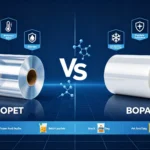
- BOPET is a stiff, dimensionally stable film with excellent optical properties and moisture barrier. It excels as an outer layer that provides mechanical rigidity, high-gloss print surface, and protection against moisture ingress.
- BOPA is a tough, flexible film with outstanding puncture and tear resistance. Its molecular structure absorbs and distributes impact energy, making it the go-to choice for products with sharp edges or that undergo rough handling and deep-draw thermoforming.
Think of BOPET as the “armour shell” that gives structure and print appeal, and BOPA as the “shock absorber” that stops punctures and flex-cracking. They are not competitors—they are complementary, but each has clear scenarios where it is the undisputed better choice.
2. Head-to-Head Property Comparison
The following table compares key technical parameters. Note that values can vary by grade and manufacturer, but the relative differences are consistent across the industry.
| Property | BOPET | BOPA (Nylon) | Implication |
|---|---|---|---|
| Tensile Strength (MD, MPa) | 180–220 | 200–250 | BOPA slightly stronger, but both are high. |
| Puncture Resistance (N) | 5–8 (moderate) | 12–18 (excellent) | Key differentiator: BOPA is superior for sharp contents. |
| Tear Resistance (MD, g/μm) | 20–30 | 60–100 | BOPA resists tear propagation far better. |
| Flex-Crack Resistance | Poor (prone to cracking under repeated flexing) | Excellent (absorbs flexing without micro-fractures) | Critical for transport and handling durability. |
| Oxygen Barrier (OTR, cm³/m²·day) | 60–120 (uncoated) | 30–50 (uncoated) | BOPA has better intrinsic oxygen barrier. |
| Moisture Barrier (WVTR, g/m²·day) | 10–20 (good) | 40–60 (poor) | BOPET wins: BOPA is hygroscopic—barrier drops in high humidity. |
| Heat Resistance (°C) | Up to 220 (melting point ~255) | Up to 200 (melting point ~220) | BOPET handles higher processing temperatures. |
| Optical Clarity & Gloss | Excellent (high gloss, low haze) | Good (slightly lower gloss, can yellow with age) | BOPET is preferred for premium graphics. |
| Density (g/cm³) | 1.38 | 1.14 | BOPA is lighter, but BOPET gives more stiffness per thickness. |
| Relative Cost | Baseline (1.0x) | 1.3–1.5x | BOPA is more expensive—justify it with performance need. |
3. When to Choose BOPET
Choose BOPET as your primary substrate when these conditions apply:
3.1 You Need a High-Quality Printing Surface
BOPET offers exceptional surface smoothness, high gloss, and low haze. It accepts gravure and flexographic inks with excellent colour reproduction and registration. For products where shelf appearance drives purchase decisions—premium snacks, cosmetics, boutique pet treats—BOPET is the undisputed outer-layer champion.
3.2 Moisture Barrier is Your Primary Concern
Unlike BOPA, which absorbs moisture and loses barrier performance, BOPET is hydrophobic. It provides stable, reliable moisture protection even in tropical or high-humidity environments. If you are packaging dry hygroscopic products like powders, biscuits, or dehydrated foods, BOPET is the safer choice.
3.3 Your Packaging Does Not Face Sharp Contents or Heavy Abuse
For products without sharp edges (e.g., flowable powders, liquids, soft confectionery), the high puncture resistance of BOPA is overkill. BOPET provides sufficient mechanical protection at a lower cost.
3.4 You Require High-Temperature Resistance
BOPET withstands higher temperatures, making it suitable for pasteurisation, hot-fill, and retort applications (when combined with appropriate sealants). BOPA can also be used in retort, but BOPET holds its properties better at extreme heat.
3.5 You Prioritise Stiffness for High-Speed Filling Lines
BOPET’s high modulus gives the laminate body and stability, which improves machinability on vertical form-fill-seal (VFFS) and horizontal form-fill-seal (HFFS) lines. It resists wrinkling and feeds smoothly, reducing downtime.
Typical BOPET-based structures:
- BOPET / PE (for dry foods with good shelf life)
- BOPET / AlOx coating / PE (for premium barrier with recyclability)
- BOPET / Al foil / CPP (for retort pouches)
4. When to Choose BOPA
Choose BOPA when any of these conditions are non-negotiable:
4.1 Your Product Contains Sharp Components
This is BOPA’s “killer application.” Kibble with bone fragments, freeze-dried meat chunks, irregularly shaped hardware, or even sharp-edged frozen vegetables will puncture BOPET with alarming ease. BOPA’s molecular orientation and crystalline structure distribute puncture energy, making it resistant to perforation. If you have ever experienced customer complaints about “holes in the bag,” BOPA is your remedy.
4.2 Your Package Undergoes Vacuum Packaging or Deep-Draw Thermoforming
BOPA’s exceptional formability and drawability make it the standard substrate for thermoformed packaging (e.g., vacuum skin packs for meat and cheese). It stretches without thinning or rupturing, conforming to the product shape. BOPET lacks this deep-draw capability.
4.3 You Need Superior Flex-Crack Resistance
During transport, packages are flexed, squeezed, and dropped. BOPET can develop microscopic cracks at flex points, which then propagate and ruin the barrier. BOPA absorbs these mechanical stresses without micro-fracturing, preserving oxygen and moisture barrier integrity. For long-distance export or e-commerce fulfilment, BOPA provides peace of mind.
4.4 Your Application Demands Good Oxygen Barrier Without Coatings
Uncoated BOPA offers better intrinsic oxygen barrier than uncoated BOPET. If you need moderate oxygen protection without the cost of EVOH or coating, BOPA can be a cost-effective middle-ground solution.
4.5 Low-Temperature Performance is Critical
BOPA maintains flexibility and impact resistance at sub-zero temperatures, whereas BOPET becomes brittle. For frozen food packaging, BOPA is the preferred substrate.
Typical BOPA-based structures:
- BOPA / EVOH / PE (for premium oxygen-sensitive kibble)
- BOPA / PE (for heavy-duty dry pet food bags)
- BOPA / CPP (for vacuum-packed meats and cheeses)
5. The Grey Zone: Applications Where Both Can Work
Many applications fall into a grey area where either BOPET or BOPA could function. In these cases, the decision comes down to a trade-off analysis.
| Application | BOPET works if… | BOPA works if… | Final recommendation |
|---|---|---|---|
| Standard dry snacks (chips, crackers) | Low puncture risk, cost-sensitive | Long export routes, premium positioning | BOPET for cost; BOPA for durability |
| Confectionery wraps | High-speed VFFS, good moisture barrier | Sharp corners from chocolate bars | BOPET (confectionery rarely demands BOPA) |
| Frozen vegetables | Short shelf life, local distribution | Sharp stems, long export, flex-crack risk | BOPA for export; BOPET for local |
| Pet treats (non-kibble) | Smooth, round pieces | Irregular, sharp-edged treats | Assess product geometry |
In these grey areas, we recommend ordering samples of both structures and conducting real-world testing—drop tests, flex tests, and shelf-life validation—under your actual supply chain conditions.
6. The Winning Combination: BOPET / BOPA Coextrusions
Often the best solution is not BOPET or BOPA, but BOPET and BOPA. A three-layer structure with BOPET on the outside (printability, stiffness, moisture barrier) and BOPA in the middle (puncture resistance, flex-crack endurance) gives you the best of both worlds. The inner layer is typically CPP or PE for sealing.
Typical high-performance structure:
BOPET (12μm) / BOPA (15μm) / CPP (50μm) or PE (50μm)
This structure is used in premium pet food, exported frozen seafood, and high-end snacks where failure is not an option. It costs more than a single-substrate solution, but it nearly eliminates package failure risk.
As a manufacturer, we offer customised coextrusion and lamination of BOPET, BOPA, and sealant films, with the ability to tailor thicknesses and barrier coatings to your exact shelf-life requirement.
7. Common Mistakes and How to Avoid Them
Mistake 1: Assuming BOPA is Always Better Because It’s “Stronger”
Strength is application-specific. BOPA is tougher, but BOPET is stiffer. Using BOPA where stiffness is needed can result in baggy, droopy packages that feed poorly on filling lines—and you pay a premium for the privilege.
Mistake 2: Ignoring Humidity When Selecting BOPA
BOPA’s oxygen barrier drops significantly at >85% relative humidity. If your products are shipped to tropical regions or stored in non-air-conditioned warehouses, EVOH or coated BOPET may be more reliable. We recommend specifying moisture-proof BOPA grades or adding a moisture barrier coating when needed.
Mistake 3: Overlooking Flex-Crack in BOPET
BOPET’s susceptibility to flex-cracking is often discovered too late—after the product has reached retail shelves with compromised barrier. For long-distance e-commerce or air-freighted goods, always consider BOPA or a BOPET with anti-crack additives.
Mistake 4: Not Balancing Cost with Risk
BOPA costs 30–50% more than BOPET. But the cost of a single product recall, customer complaint, or lost brand trust far outweighs the material premium. A proper cost-risk analysis—considering your distribution environment—is essential.
8. Decision-Making Flowchart (Simplified)
To summarise, apply this quick decision logic:
- Is your product sharp, heavy, or irregularly shaped? → Yes → BOPA is likely required.
- Will the packaging face rough transport, stacking, or flexing? → Yes → BOPA is recommended.
- Do you need high-gloss printing and a stiff package feel? → Yes → BOPET is preferred.
- Is your packaging exposed to high humidity? → Yes → BOPET is safer, or use moisture-protected BOPA.
- Are you prioritising cost reduction? → BOPET is more economical, but ensure it meets all performance thresholds.
- When in doubt, test both → Our lab can provide comparative samples for your specific packaging line and distribution test.
9. Summary: Choosing the Right Partner Matters
Ultimately, the choice between BOPET and BOPA is not just a material decision—it is a partnership decision. A knowledgeable film supplier will help you navigate the trade-offs, recommend appropriate grades, and provide consistent quality that ensures your packaging performs as expected, every time.
We are a professional flexible packaging film manufacturer headquartered in China, with a comprehensive portfolio that includes BOPET, BOPA, CPP, high-barrier, and eco-recyclable films. Our technical team works with you from material selection through to production trials, ensuring your final laminate structure delivers the right balance of performance, cost, and sustainability—for your specific product, market, and supply chain.
Whether you need standard rolls or fully customised solutions, we offer stable quality, intelligent production, on-time delivery, and full export support to clients across Southeast Asia, the Middle East, Europe, North America, Australia, and South America.
Ready to choose the right film for your project? Contact us today to request free samples, discuss your packaging application, or receive a professional laminate structural recommendation tailored to your products.
Message us for more information