Pet Food Packaging: High-Performance Film Solutions for Freshness, Puncture Resistance & Shelf Appeal
07.28.2026
The global pet food industry is experiencing remarkable growth, driven by humanisation trends, premiumisation, and a surge in pet ownership. According to industry reports, the pet food packaging market is projected to exceed USD 15 billion by 2028. As brands compete for shelf space and consumer loyalty, packaging has evolved from a mere container to a strategic brand asset that must preserve nutritional integrity, ensure product safety, and communicate quality—all while meeting increasingly stringent sustainability expectations.
At the heart of effective pet food packaging lies the flexible film structure. Whether for dry kibble, wet pouches, treats, or freeze-dried raw diets, the choice of substrates—BOPA (nylon), BOPET, CPP, and high-barrier films—directly impacts product shelf life, brand perception, and supply chain efficiency. This article provides a comprehensive guide to pet food packaging film selection, covering material properties, structural design, common pitfalls, and emerging trends.
1. Understanding the Demands of Pet Food Packaging
Pet food presents unique challenges compared to human food packaging. It is often high in fat content, prone to oxidation, and contains sharp kibble pieces that can puncture thin films. Moreover, pet owners are increasingly discerning; they expect packaging that keeps food fresh, is easy to open and reseal, and displays appealing visual design. Key performance requirements include:
-
-
Oxygen barrier: To prevent rancidity of fats and preserve nutritional value (vitamins, essential fatty acids).
-
Moisture barrier: To avoid mould growth and maintain texture (crunchiness for kibble).
-
-
Light protection: Especially for UV-sensitive ingredients like some vitamins and natural pigments.
-
Puncture and tear resistance: To withstand rough handling during shipping, shelf stocking, and consumer use.
-
Seal integrity: To prevent leaks, especially for wet pet food pouches.
-
Printability and aesthetics: High-impact graphics that convey brand story and product quality.
-
Sustainability: Increasing demand for recyclable or reduced-carbon packaging solutions.
2. Core Film Materials for Pet Food Packaging
No single material can meet all these demands. Therefore, pet food packaging typically employs multilayer laminates that combine the strengths of different films. Below are the most common materials used and their specific roles.
2.1 BOPA (Biaxially Oriented Polyamide / Nylon)
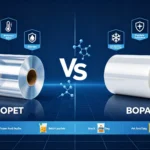
BOPA is a workhorse in pet food packaging, particularly for dry kibble and treats. Its outstanding puncture resistance makes it ideal for protecting against sharp bone fragments or kibble edges. Nylon also exhibits excellent tensile strength, flexibility, and low-temperature performance. However, its oxygen barrier is moderate, so it is often coated or combined with EVOH (ethylene vinyl alcohol) or other barrier layers. BOPA also offers good clarity and gloss, enhancing shelf appeal.
2.2 BOPET (Biaxially Oriented Polyester)
BOPET is valued for its high tensile strength, stiffness, and excellent optical properties (clarity and gloss). It provides a stable print substrate for high-definition graphics and is often used as the outer layer in laminate structures. While BOPET has moderate oxygen barrier, it excels as a moisture barrier. Metallised BOPET is a popular choice for adding a premium look while providing enhanced gas and light barrier—common in premium treat packaging.
2.3 CPP (Cast Polypropylene)
CPP is the sealant layer of choice in many pet food laminates. It offers a wide heat-seal range, excellent hot-tack strength, and good moisture barrier. CPP also provides good puncture resistance and clarity. It can be formulated for different seal initiations, making it suitable for high-speed form-fill-seal (FFS) applications. For high-temperature filling (e.g., retort pouches for wet food), higher melting point CPP grades are available.
2.4 High-Barrier Films (EVOH, PVDC, AlOx, SiOx)
For sensitive pet food recipes with high fat content or premium nutritional supplements, high-barrier films are essential. EVOH (ethylene vinyl alcohol) is the most common transparent barrier material, offering exceptional oxygen barrier when dry. It is often co-extruded or laminated as a thin core layer between BOPA or BOPET and CPP. PVDC (polyvinylidene chloride) provides excellent gas and moisture barrier but poses recycling challenges. For premium sustainable options, clear AlOx (aluminium oxide) or SiOx (silicon oxide) coatings are applied via vacuum deposition to achieve high barrier performance with better recyclability.
2.5 Eco-Recyclable & Mono-Material Structures
In response to global packaging regulations and consumer preference, mono-material PE or PP structures with enhanced barrier coatings are gaining traction. These designs aim to be fully recyclable in PE or PP streams while maintaining adequate shelf life. For pet food, these are currently more suitable for short-shelf-life dry treats rather than high-fat kibble, but technology is rapidly evolving.
3. Recommended Laminate Structures for Pet Food Applications
The optimal structure depends on the product type, shelf life requirement, and packaging format. Below are typical structures used across the industry.
3.1 Dry Kibble (Standard Shelf Life: 12–18 months)
-
Structure: BOPA / EVOH / PE or BOPA / PE (with high-barrier coating)
-
Thickness: 15μm BOPA + 15μm EVOH + 50μm PE
-
Why: The BOPA provides puncture resistance; EVOH offers oxygen barrier; PE ensures sealability and moisture protection.
3.2 Premium Treats & High-Fat Recipes
-
Structure: BOPET / AlOx or SiOx coating / BOPA / CPP
-
Thickness: 12μm BOPET + coating + 15μm BOPA + 50μm CPP
-
Why: BOPET provides stiffness and printability; the high-barrier coating protects against oxidation; BOPA adds puncture resistance; CPP provides reliable seals.
3.3 Wet/Fresh Pet Food Pouches (Retort)
-
Structure: BOPET / Aluminium foil / CPP (retort grade)
-
Thickness: 12μm BOPET / 12μm Al foil / 70μm CPP
-
Why: Aluminium foil offers 100% light, oxygen, and moisture barrier, critical for sterilised wet food. CPP retort grade withstands high-temperature processing (121°C).
3.4 Eco-Conscious Dry Snack Packaging
-
Structure: MDO-PE / PE-based barrier coating / PE sealant (all-PE mono-material)
-
Thickness: 25μm MDO-PE + coating + 40μm PE
-
Why: Fully recyclable in PE stream; suitable for short-shelf-life snacks; MDO-PE provides stiffness and puncture resistance comparable to PET.
4. Key Performance Attributes in Detail
4.1 Oxygen Transmission Rate (OTR)
OTR is the most critical parameter for fat-containing pet food. Oxidation leads to rancidity, off-odours, and loss of essential nutrients. Standard BOPA/PE laminates offer OTR around 30–50 cm³/m²·day. With EVOH or AlOx coating, OTR can be reduced to below 5 cm³/m²·day, extending shelf life from 6 months to over 24 months. For wet food, aluminium foil brings OTR to near zero.
4.2 Water Vapour Transmission Rate (WVTR)
Moisture ingress causes kibble to lose crunchiness and fosters mould growth. Good moisture barrier is essential. BOPET and CPP provide excellent WVTR; when combined with aluminium foil, the structure becomes virtually impermeable to water vapour. For dry climates, simpler structures may suffice, but for humid markets, high-WVTR materials are non-negotiable.
4.3 Puncture & Flex-Crack Resistance
Sharp kibble or freeze-dried pieces can easily perforate weak films during transportation. BOPA is the gold standard here, absorbing impact energy and resisting tearing. For structures without BOPA, thicker PE layers or the addition of a tough outer layer like BOPET can provide adequate protection.
4.4 Seal Strength & Integrity
Weak seals lead to leaks, contamination, and product loss. CPP offers consistent seal strength, but the sealant layer must be matched to the filling conditions (temperature, speed). For hermetic sealing, especially for vacuum-packed products, the sealant should have high hot-tack and broad sealing window.
5. Common Pitfalls in Pet Food Packaging Design
-
Underestimating puncture risk: Using standard PE/PE structures without a puncture-resistant layer leads to high package failure rates during shipping.
-
Ignoring flex-cracking: Repeated flexing (e.g., during handling) can cause micro-cracks in barrier coatings, drastically reducing shelf life—especially in metallised films.
-
Overlooking sealant compatibility: High-fat pet food can contaminate seal areas, causing seal failure. Using a sealant with oil-resistant properties or designing a wider seal bead is essential.
-
Assuming all EVOH is equal: EVOH’s barrier drops sharply at high humidity; for humid markets, moisture-protected EVOH or a different barrier strategy is required.
-
Sustainability claims without verification: Claiming “recyclable” without testing with existing recycling streams can lead to greenwashing accusations. Mono-material structures or certified recyclable designs are the way forward.
6. Sustainability and the Future of Pet Food Packaging
Regulatory pressure and consumer demand are forcing brands to rethink packaging. The EU’s Packaging and Packaging Waste Regulation (PPWR), US state-level EPR laws, and global corporate commitments are pushing for reduction, reuse, and recyclability.
Our company is at the forefront of this transition. We offer a range of eco-recyclable films, including all-PE and all-PP mono-material structures, which maintain key properties like puncture resistance and barrier performance while being compatible with existing recycling streams. For high-barrier applications, we provide transparent coated films (SiOx/AlOx) that allow for recycling without the need for aluminium foil. Additionally, our lightweighting solutions reduce material usage without compromising protection, cutting both costs and carbon footprint.
7. Why Partner with Us for Your Pet Food Packaging?
As a professional flexible packaging film manufacturer headquartered in China, we bring over a decade of experience in supplying films to leading pet food brands and packaging converters globally. Our advantages include:
-
Comprehensive product portfolio: BOPA, BOPET, CPP, high-barrier, holographic, and eco-recyclable films—all under one roof.
-
Custom formulation: We tailor structures, thicknesses, and surface treatments to your specific product needs and packaging machinery.
-
Strict quality control: Our intelligent workshops and online QC systems ensure consistent thickness, optical properties, and seal performance across every roll.
-
Global export expertise: We have served clients in Southeast Asia, the Middle East, Europe, North America, Australia, and South America, with full export documentation and logistics support.
-
Technical support: From material selection to troubleshooting on your filling lines, our R&D team works alongside you to optimise performance and cost.
Conclusion
Pet food packaging is more than just a protective cover—it is a critical component of product quality, brand differentiation, and sustainability strategy. By selecting the right combination of BOPA, BOPET, CPP, and high-barrier films, brands can ensure longer shelf life, fewer returns, and happier pets and owners. As the industry moves toward circularity, innovative mono-material and coated film solutions are reshaping the landscape.
We invite you to explore our full range of films and request samples for your next pet food packaging project. Whether you need standard laminates or fully customised structures, our team is ready to deliver reliable, cost-effective, and sustainable solutions.
Contact us today to discuss your pet food packaging requirements and discover how we can help you stand out on the shelf—and in the recycling stream.
Message us for more information

08-18-2026
BOPET vs BOPA – Don’t Just Look at the Price