PE Protective Film Adhesion Systems: Acrylic vs Rubber-Based, Removability & Weathering
Published: October 30, 2026
|
Two rolls of PE protective film can look identical — same thickness, same color, same roll width — and behave completely differently in the field. One peels off cleanly after eight months on a stainless steel panel. The other leaves a ghosted adhesive outline that cannot be wiped off, and the customer rejects the shipment.
The difference is almost never the polyethylene. It is the adhesive system.
Protective film adhesion is a balance of three forces that pull against each other: it must hold firmly enough to survive handling, stacking, CNC processing and ocean freight; it must release cleanly when the job is done; and it must stay stable for months of heat, humidity and sunlight without drifting. Choosing between acrylic and rubber-based adhesive determines how that balance resolves — and it is the single most consequential specification decision a buyer makes.
This guide compares both chemistries on the metrics that matter in production: peel force, adhesion build-up, residue behaviour, temperature limits, low-surface-energy performance and UV weathering. It ends with a substrate selection matrix and a testing protocol you can use to qualify a supplier before placing a bulk order.
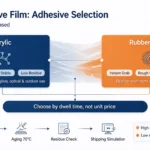
Acrylic adhesives win on removability and weathering — they resist UV, do not yellow, and leave no residue even after long dwell times, which is why they dominate optical, display and outdoor applications. Rubber-based adhesives win on initial grab and cost — they bite instantly on rough or low-surface-energy substrates and cost 20–40% less, but they build adhesion over time and degrade under UV. Match the chemistry to the substrate and the dwell time, not to the price per roll.
1. What “Adhesion” Actually Means in Protective Film
Before comparing chemistries, it helps to be precise about terminology, because suppliers quote adhesion in ways that are not always comparable.
1.1 Peel force, not “stickiness”
Protective film adhesion is measured as peel force — the force required to pull the film off a standard test panel at a controlled angle and speed, expressed in g/25mm (or g/inch, or N/25mm). The standard method is a 180° peel test on a stainless steel or glass panel after a defined dwell time (ASTM D3330, PSTC-101, FINAT FTM 1, ISO 29862).
This number is meaningless without its test conditions. A supplier claiming “50 g/25mm adhesion” may have measured it after 20 minutes on stainless steel, or after 24 hours on glass, or after 72 hours at 70°C. Those are three very different films. Always ask for dwell time, substrate and peel speed together with the number.
1.2 Initial tack vs ultimate adhesion
Two distinct properties matter:
- Initial tack — the instant grab when the film first touches the surface. It determines whether the film stays in place during lamination and whether it can bridge rough surfaces. Measured by loop tack (ASTM D6195) or probe tack.
- Ultimate adhesion — the peel force after the adhesive has fully wet out the substrate, typically reached after 24–72 hours. This is what governs how hard the film is to remove at the end of the job.
The gap between these two numbers is where most protective film problems live. A film with high initial tack but low ultimate adhesion is easy to apply and easy to remove. A film whose ultimate adhesion creeps upward over weeks is easy to apply and impossible to remove cleanly — this is the adhesion build-up problem, covered in Section 6.
2. Acrylic Adhesive Systems: The Precision Choice
Acrylic pressure-sensitive adhesives are built from acrylic copolymer chains — typically a copolymer of butyl acrylate and acrylic acid, sometimes with 2-EHA or other monomers to tune the glass transition temperature. What makes acrylic systems distinctive is that they are single-phase polymers: there is no separate tackifier resin that can migrate.
2.1 Three acrylic formats
| Format | How it is made | Trade-off |
|---|---|---|
| Solvent acrylic | Acrylic polymer dissolved in organic solvent, coated, then dried; crosslinked with isocyanate | Best peel stability and precision; high performance per gram. Downside is VOC emissions during coating. |
| Emulsion acrylic | Water-based acrylic dispersion; crosslinked with aziridine or carbodiimide | Low VOC, lower cost, easier compliance with EU/US solvent rules. Slightly more sensitive to humidity during coating and drying. |
| UV-cured acrylic | Solvent-free acrylic syrup cured by UV radiation | Very thin adhesive layers, high coating speed, precise low-tack control. Requires dedicated equipment. |
2.2 How crosslinking controls peel force
In acrylic systems, peel force is tuned primarily through crosslink density. More crosslinking raises the cohesive strength of the adhesive layer — it becomes stiffer, flows less into the substrate’s micro-roughness, makes less contact, and therefore peels more easily. Less crosslinking gives a softer, wetter adhesive that grips more but risks cohesive splitting and residue.
This gives acrylic chemists a clean dial: a single base polymer can be crosslinked to produce anything from a 5 g/25mm optical-grade film for polarizer protection to a 150 g/25mm grade for deep-drawn aluminium. It is why one acrylic platform can serve an entire product family with predictable behaviour.
2.3 Where acrylic wins
- Clean removal after long dwell. Because there is no migrating tackifier, an acrylic film held for 12 months at 40°C still releases at close to its original peel force, leaving nothing behind on glass, stainless steel or acrylic sheet.
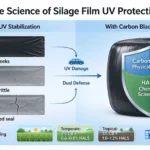
- UV and oxidation resistance. The acrylic backbone is saturated — there are no double bonds for UV to attack. No yellowing, no embrittlement, no tack loss after months outdoors. This is why outdoor-rated protective films are almost always acrylic.
- No ghosting on high-gloss surfaces. Ghosting — the faint adhesive outline visible on gloss black plastic, painted panels or display glass after removal — is caused by tackifier or oligomer residue. Acrylic systems essentially eliminate it.
- Higher temperature ceiling. Crosslinked acrylic holds shear strength to 90–120°C, surviving paint bake ovens, hot lamination and summer container interiors without slippage.
- Optical clarity. Acrylic adhesives can be formulated to near-water-white, which matters for transparent film on display glass and polarizers.
2.4 Where acrylic struggles
- Lower initial tack. Acrylic adhesive is slower to wet out. On a rough or dusty surface, film may lift at edges in the first hours before ultimate adhesion develops. Handling within the first 24 hours needs care.
- Weak on low-surface-energy substrates. On PP, PE or powder-coated surfaces below roughly 32 dyn/cm, standard acrylic grades may not develop enough peel force to stay put through processing.
- Higher cost. Acrylic polymer and crosslinker packages typically cost 20–40% more than rubber-based alternatives at equivalent thickness.
- Poor cold grab. Below about 5°C, wet-out slows dramatically and initial adhesion drops; cold-weather application may need a higher-tack grade.
3. Rubber-Based Adhesive Systems: The High-Grab Choice
Rubber-based adhesives are blends, not single polymers. The formulation combines an elastomer — natural rubber, styrene-butadiene rubber (SBR), or a styrenic block copolymer such as SIS or SBS — with a tackifying resin (rosin ester, terpene phenol, or hydrocarbon resin) plus plasticizers and antioxidants. The elastomer provides elasticity and cohesion; the tackifier provides the instant grab.
3.1 Why rubber grabs so hard
The tackifier resin lowers the glass transition temperature of the blend and makes the adhesive soft and highly conformable at room temperature. It flows into surface micro-roughness within seconds rather than hours, which is why rubber-based film sticks immediately to brushed metal, textured plastic and slightly dusty surfaces where acrylic would need a day to develop the same bond.
This makes rubber the practical choice for heavy industrial protection: steel plate in a fabrication yard, aluminium sheet going through shearing and bending, building panels stored outdoors for a few weeks.
3.2 Where rubber fails: the migration problem
The same tackifier that provides the grab is also the system’s weakness. Tackifier resins are relatively low molecular weight and are not chemically bound into the polymer network. Over time — accelerated by heat, sunlight and pressure — they migrate toward the adhesive-substrate interface and into the substrate itself.
The consequences are predictable and well documented in the field:
- Adhesion build-up. As tackifier accumulates at the interface, peel force climbs — often 2–5× the initial value over six months. Film that peeled at 60 g/25mm on day one may require 250 g/25mm at month six, and will tear or leave residue when pulled.
- Ghosting and staining. On high-gloss acrylic sheet, gloss black plastic or painted metal, migrated resin leaves a visible outline that cannot be removed with a dry wipe and sometimes not with solvent.
- Yellowing. Residual unsaturation in natural rubber and many tackifiers oxidizes under UV, turning the adhesive — and the surface beneath it — yellow-brown. Critical failure on white appliances, light-colored panels and display glass.
- Cohesive failure at high temperature. Rubber adhesives soften sharply above 60–70°C. Under summer container heat or paint-bake exposure, the adhesive layer can split internally, transferring adhesive mass onto the substrate instead of releasing cleanly at the interface.
- Poor cold performance. Below roughly 0°C, the blend stiffens and tack collapses; film may lift at edges during winter transport.
These are not defects of a bad supplier — they are inherent to the chemistry. A well-formulated rubber adhesive with good antioxidants performs noticeably better, but no rubber system matches acrylic on long-dwell residue performance.
4. Head-to-Head Comparison
The table below summarizes the two chemistries across the parameters that determine whether a protective film succeeds in a given application. Values reflect typical commercial grades; specific products vary.
| Parameter | Acrylic | Rubber-based |
|---|---|---|
| Initial tack | Low to moderate; needs 24–72 h to reach full bond | High; immediate grab within seconds |
| Typical peel range | 3–200 g/25mm, tightly controlled | 100–500 g/25mm, wider spread |
| Peel stability over time | Excellent; typically +10–50% over 6 months | Poor; commonly +100–400% over 6 months |
| Residue risk after removal | Very low | Moderate to high, rises sharply with dwell time |
| UV / outdoor weathering | Excellent; no yellowing, stable tack | Poor; oxidizes, yellows, loses tack within weeks |
| High-temperature shear | Good; 90–120°C | Limited; 60–70°C before softening |
| Low-surface-energy adhesion | Adequate only with special high-tack grades | Good; best choice for PP, PE and powder coatings |
| Ghosting on gloss surfaces | Minimal | Common risk |
| Relative cost | Baseline +20–40% | Baseline |
| Best-fit applications | Optical film, display glass, acrylic sheet, outdoor storage, long dwell, appliance panels | Steel and aluminium processing, construction panels, short-term protection, LSE plastics |
5. Removability: Why Some Films Leave Residue
“Residue-free” is the most over-claimed phrase in the protective film industry. Understanding the failure mode makes it possible to test for it rather than trust it.
5.1 Adhesive failure vs cohesive failure
When you pull a protective film off a surface, the break can happen at two different places, and only one of them is clean:
| Failure mode | What happens | Result |
|---|---|---|
| Interfacial (adhesive) failure | The adhesive releases from the substrate surface; the adhesive layer stays intact on the film | Clean surface. This is what you want. |
| Cohesive failure | The adhesive layer splits internally — part stays on the film, part transfers to the substrate | Residue. Requires solvent cleaning or scrapping the part. |
Cohesive failure happens when the adhesive’s internal strength is lower than its bond to the surface. Three conditions make this likely: too little crosslinking (soft, weakly cohesive adhesive), too much tackifier migration (interface bond strengthens while bulk weakens), and elevated temperature (both effects accelerate). Rubber-based systems are structurally more exposed to all three.
5.2 Substrate surface energy: the other half of the equation
Removability is not a property of the film alone — it is a property of the film-substrate pair. Substrate surface energy determines how strongly any adhesive can bond:
| Substrate | Surface energy (dyn/cm) | Bonding behaviour | Recommended tack |
|---|---|---|---|
| Stainless steel | ~1,000–1,500 | Very strong bond; high residue risk if tack too high | Low (10–40 g/25mm) |
| Aluminium | ~840 | Strong bond; oxide layer can transfer | Low to medium (20–60 g/25mm) |
| Glass | ~250–500 | Strong, uniform bond; excellent for peel testing | Low (10–50 g/25mm) |
| Polycarbonate | ~42–46 | Moderate; solvent stress-cracking risk with some adhesives | Low (10–30 g/25mm) |
| PET | ~41–44 | Moderate to good | Low to medium (15–50 g/25mm) |
| Acrylic (PMMA) sheet | ~38–40 | Susceptible to ghosting and solvent attack | Low (10–30 g/25mm), acrylic adhesive |
| Rigid PVC | ~39–42 | Good; plasticizer migration can soften adhesive | Low to medium (20–60 g/25mm) |
| PP / PE | ~29–31 | Weak bonding — needs high tack or corona treatment | High (60–200 g/25mm) |
| Powder-coated metal | Variable, often 30–38 | Textured surface; needs conformable high-tack adhesive | High (60–150 g/25mm), rubber-based |
The practical rule: the higher the substrate surface energy, the lower the tack you need. A 200 g/25mm film on stainless steel is not “extra secure” — it is a residue incident waiting for a summer shipment. Conversely, a 15 g/25mm film on PP will lift at the edges within a day.
5.3 Three factors that shorten removal life
- Dwell time. Adhesion builds as the adhesive wets out the substrate. Most of the build happens in the first 72 hours, but migration-driven growth continues for months.
- Temperature. Every 10°C of sustained heat roughly doubles tackifier mobility. A film rated for six months at 25°C may fail at 12 weeks in a 45°C warehouse.
- Pressure during stacking. Pallets stacked three high impose continuous compressive load on the film, forcing adhesive into surface pores and accelerating both wet-out and migration.
6. The Adhesion Build-Up Problem
Adhesion build-up deserves its own section because it is the most common cause of protective film complaints, and it is invisible at the time of purchase. A buyer tests a sample, finds the peel comfortable, places an order — and discovers at the end of the production run that the film will not come off.
The chart below compares typical peel-force drift between the two chemistries under accelerated aging (40°C, 90% RH, six months equivalent):
| Acrylic, low tack |
|
12 → 18 |
| Acrylic, medium tack |
|
40 → 56 |
| Rubber-based, medium tack |
|
70 → 195 |
| Rubber-based, high tack |
|
110 → 290 |
| Acrylic final | Rubber final | Initial value marker |
The scale runs 0–300 g/25mm. Note what the numbers mean in practice: acrylic low tack drifts from 12 to 18 g/25mm — a 50% increase that is unnoticeable to an operator. Rubber medium tack drifts from 70 to 195 g/25mm — nearly triple, enough to tear a thin film mid-peel and leave adhesive behind on a gloss surface.
A sample is usually tested within days of arrival, at room temperature, and peeled within hours. That conditions test the initial peel force — the number that looks best on a datasheet. Real production conditions test the ultimate peel force after weeks or months of dwell, heat and stacking. Always request aging data (70°C × 7 days is a common accelerated proxy) rather than relying on a fresh-sample peel test.
7. Weathering Performance: UV, Heat and Humidity
Weathering is where the chemistry gap becomes unbridgeable. Protective film used outdoors, or stored in a container on a dock, faces UV radiation, thermal cycling and moisture — and the two adhesive families respond very differently.
7.1 Why acrylic survives UV
The acrylic polymer backbone is fully saturated — it contains no carbon-carbon double bonds. UV photons in the 290–400 nm range do not have a chromophore to attack, so the polymer does not undergo the chain-scission and oxidation cascade that destroys unsaturated rubbers. In practice this means acrylic adhesive on a UV-stabilized PE carrier will hold its peel force and remain non-yellowing through a full outdoor season.
7.2 How rubber degrades
Natural rubber and most tackifier resins contain residual double bonds that are highly susceptible to UV-initiated oxidation. The degradation sequence is well known: the double bonds react with oxygen under UV to form hydroperoxides, which decompose into radicals, which attack the polymer chain. Visible symptoms appear in a predictable order — tack increase first, then yellowing, then embrittlement and cohesive failure. Antioxidants slow this but cannot stop it, and the antioxidants themselves are consumed.
A typical rubber-based protective film exposed to direct summer sun begins showing measurable yellowing within four to six weeks. Acrylic equivalents show no color change after twelve months.
7.3 Practical weathering ratings
| Exposure condition | Acrylic | Rubber-based |
|---|---|---|
| Indoor, climate-controlled | 12+ months | 6–12 months |
| Warehouse, unheated (0–40°C) | 9–12 months | 3–6 months |
| Ocean container, tropical route | 4–8 weeks | 1–3 weeks |
| Outdoor, direct sun, temperate | 6–12 months | 3–6 weeks |
| Outdoor, direct sun, tropical | 3–6 months | 2–4 weeks |
Note that these figures assume a UV-stabilized PE carrier. The carrier film matters as much as the adhesive: unprotected PE embrittles and cracks under UV long before the adhesive fails, and once the carrier cracks, moisture reaches the adhesive interface. Outdoor grades combine a UV-stabilized carrier with an acrylic adhesive — one without the other does not deliver outdoor performance.
A steel shipping container sitting on a tropical dock can reach 65–75°C internally. At that temperature rubber adhesive is above its softening range: it flows, builds adhesion against the substrate and, on cooling, locks in place. Film that passed a 25°C peel test in the factory can be effectively welded on arrival. For any shipment crossing the tropics, specify acrylic and verify a 70°C × 7 day aging test.
8. Selection Guide by Substrate and Application
Use the matrix below as a starting point, then confirm with an actual sample trial under your production conditions.
| Application | Adhesive | Target peel | Why |
|---|---|---|---|
| Polarizer / optical film | Acrylic, ultra-low tack | 3–10 g/25mm | Zero residue and no optical distortion; any adhesive transfer scraps the part |
| Display glass / cover glass | Acrylic, low tack | 10–30 g/25mm | High surface energy substrate; low tack is enough and preserves removability |
| Acrylic sheet / high-gloss plastic | Acrylic, low tack | 10–30 g/25mm | Ghosting risk is the dominant concern; rubber tackifiers stain PMMA |
| Stainless steel / aluminium sheet | Acrylic, low to medium | 20–60 g/25mm | Very high surface energy; acrylic resists the heat of downstream processes |
| Appliance panels (painted) | Acrylic, low to medium | 20–50 g/25mm | No yellowing on white/light finishes; survives bake and assembly heat |
| Outdoor building panels / profiles | Acrylic + UV-stabilized carrier | 30–80 g/25mm | Direct sun exposure for months; only acrylic holds tack without yellowing |
| Steel plate in fabrication yard | Rubber-based, high tack | 80–200 g/25mm | Rough, dusty surface; short dwell (days to weeks); cost matters at volume |
| PP / PE moulded parts | Rubber-based, high tack | 60–150 g/25mm | Low surface energy; standard acrylic will not hold without corona treatment |
| Powder-coated profiles | Rubber-based, high tack | 60–150 g/25mm | Textured low-energy surface needs a soft, conformable adhesive |
| Electronics / ESD-sensitive parts | Antistatic acrylic | 10–40 g/25mm | Antistatic performance plus residue-free removal on sensitive assemblies |
9. How to Test and Verify Before Ordering
A datasheet cannot tell you whether a film will come off cleanly in your process. These five tests, most of which can be run in-house, will.
| Test | Method | What it reveals |
|---|---|---|
| 180° peel test | ASTM D3330 / PSTC-101, on your actual substrate, after 24 h dwell | Baseline peel force; establishes the number you will compare against |
| Accelerated aging | 70°C × 7 days, then re-run peel test and inspect for residue | Adhesion build-up and cohesive failure risk — the single most valuable test |
| Residue inspection | Peel aged samples over a black gloss surface; inspect under raking light; wipe with isopropanol on white cloth | Ghosting and adhesive transfer that visual inspection on metal would miss |
| Weathering test | QUV / ASTM G154 or ISO 4892-2, 200–500 h; measure color change (ΔE) and peel drift | Whether the grade is genuinely outdoor-capable or only labelled so |
| Container simulation | Sealed chamber at 65°C / 90% RH for 14 days with stacked panels | Real shipping risk under compression and tropical heat |
9.1 Questions to ask a supplier
- “Is the adhesive acrylic or rubber-based, and is it solvent, emulsion or UV-cured?”
- “What is the peel force on my substrate, at what dwell time, measured to which standard?”
- “Can you provide peel data after 70°C × 7 days aging, not just fresh-sample data?”
- “Is the carrier UV-stabilized, and is the grade rated for outdoor use?”
- “What is the maximum recommended dwell time at 25°C and at 40°C?”
- “Do you offer a written residue guarantee, and what are its conditions?”
10. Common Failures and Their Root Causes
| Symptom | Likely cause | Fix |
|---|---|---|
| Film lifts at edges within 24 h | Tack too low for the substrate; or LSE surface with standard acrylic | Step up one tack grade; use rubber-based on PP/PE; apply with roller pressure |
| Adhesive transfers to surface on removal | Cohesive failure from insufficient crosslinking or rubber tackifier migration | Switch to crosslinked acrylic; reduce dwell time; lower storage temperature |
| Faint outline remains on gloss surface | Tackifier or oligomer migration (ghosting) | Acrylic adhesive only; verify with black-gloss residue test before ordering |
| Film turns yellow in storage | Rubber oxidation under UV or heat | Acrylic adhesive; store rolls away from sunlight and heat sources |
| Film tears during peel | Peel force exceeded film tensile strength — adhesion build-up or excessive tack | Reduce tack grade; increase carrier thickness; peel at a slower angle |
| Film slips during CNC or bending | Insufficient shear strength at process temperature | Higher crosslink density acrylic; verify shear at actual process temperature |
| Edge curl after lamination | Carrier tension imbalance or excessive winding tension | Adjust lamination tension; confirm roll winding tension spec with supplier |
11. Conclusion: Choose by Dwell Time, Not Unit Price
The acrylic-versus-rubber decision is not a quality hierarchy — it is a fit question. Rubber-based adhesive is the correct engineering choice for protecting rough steel through a two-week fabrication cycle. Acrylic is the correct choice for protecting a polarizer for a year. The failures happen when a buyer optimises for price per roll and ignores how long the film will stay on.
Three rules summarize the analysis:
- Match chemistry to dwell time. Under four weeks on a rough surface, rubber is cost-effective and performs well. Beyond three months, on a smooth or high-value surface, acrylic is the only defensible choice. Anything crossing the tropics in a container should be acrylic regardless of dwell.
- Match tack to substrate surface energy. High-energy substrates like stainless steel and glass need less tack, not more. Low-energy substrates like PP and powder coatings need more, which usually means rubber-based or a specially formulated high-tack acrylic.
- Test after aging, not on arrival. A fresh-sample peel test measures the least relevant number. Request 70°C × 7 day data, run a residue check on black gloss, and simulate container conditions for export orders.
The cost of getting this wrong is not the price difference between adhesive systems — it is a rejected shipment, a rework line, or a scrapped batch of optical parts. Against that, the 20–40% premium for acrylic is usually the cheapest insurance in the specification.
Not sure which adhesion system fits your substrate?
Send us your substrate material, expected dwell time and any post-processing steps. Our technical team will recommend an adhesive chemistry and peel grade, and supply free samples with 70°C aging data for your own trial.
|
Related articles
Message us for more information