PA vs PP vs PE vs PET Film: Complete Performance & Application Comparison Guide
PA, PP, PE, and PET are the four most widely used plastic film substrates in food packaging, dairy containers, in-mold labeling (IML), and industrial packaging fields. Each material has unique inherent properties in mechanical performance, barrier capability, temperature resistance, and processability. Selecting the wrong substrate will directly cause production defects such as film cracking, printing peeling, composite delamination, and shortened product shelf life, bringing unnecessary production loss and quality risks.
This guide systematically compares the core performance, processing adaptability, environmental tolerance, compliance, cost, and applicable scenarios of PA, PP, PE, and PET films with detailed comparison tables. It provides a reliable selection basis for packaging engineers, injection molders, printing and composite factories, and packaging purchasers.
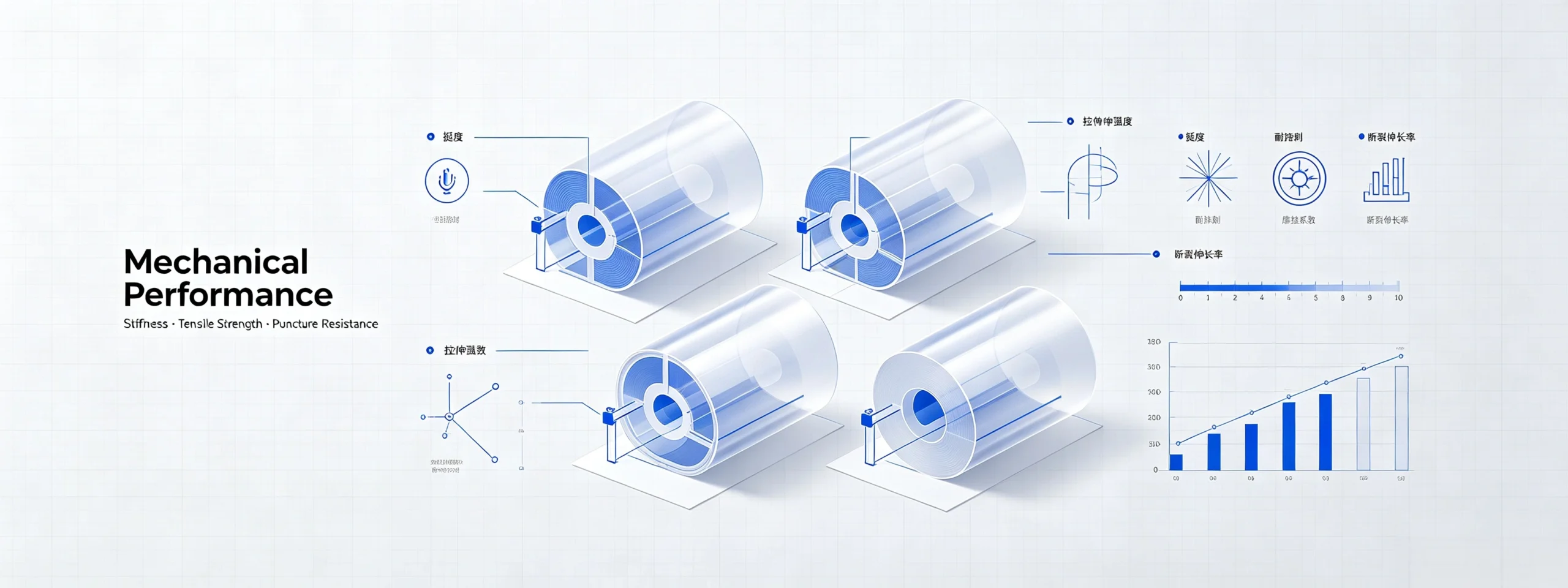
1. Basic Mechanical Performance Comparison
Mechanical properties determine the film’s adaptability to high-speed production, stacking, transportation, and end-use extrusion and impact. Stiffness, tensile strength, puncture resistance, and friction characteristics are core indicators for IML labeling, printed film, and flexible packaging production.
| Performance Index | PA (Nylon) Film | PP (Polypropylene) Film | PE (Polyethylene) Film | PET (Polyester) Film |
|---|---|---|---|---|
| Stiffness & Flatness | Medium-high, excellent dimensional stability, not easy to curl | High stiffness, outstanding flatness, ideal for IML robotic picking | Low stiffness, soft texture, prone to sagging and deformation | Highest stiffness, ultra-stable flatness, no deformation under normal pressure |
| Tensile Strength | Excellent, strong tensile resistance in both MD/TD directions | Medium, stable tensile performance with slight direction difference | Lowest, easy to stretch and deform under external force | Superior, ultra-high tensile strength with minimal deformation |
| Puncture Resistance | Best in four substrates, resistant to sharp particle piercing | Poor, easy to be punctured by hard sharp objects | Medium, flexible buffer but weak against strong piercing | Medium-high, rigid puncture resistance but brittle under extreme impact |
| Friction Coefficient & Static Performance | Moderate friction, easy static accumulation, requires anti-static treatment | Controllable friction, stable stacking separation, suitable for high-speed feeding | High friction, prone to film adhesion and double picking | Low friction, smooth surface, easy static generation |
| Elongation at Break | High toughness, resistant to bending and folding damage | Low elongation, rigid and easy to crack under forced bending | Highest elongation, excellent flexibility and toughness | Low elongation, poor flexibility, brittle fracture risk under severe bending |
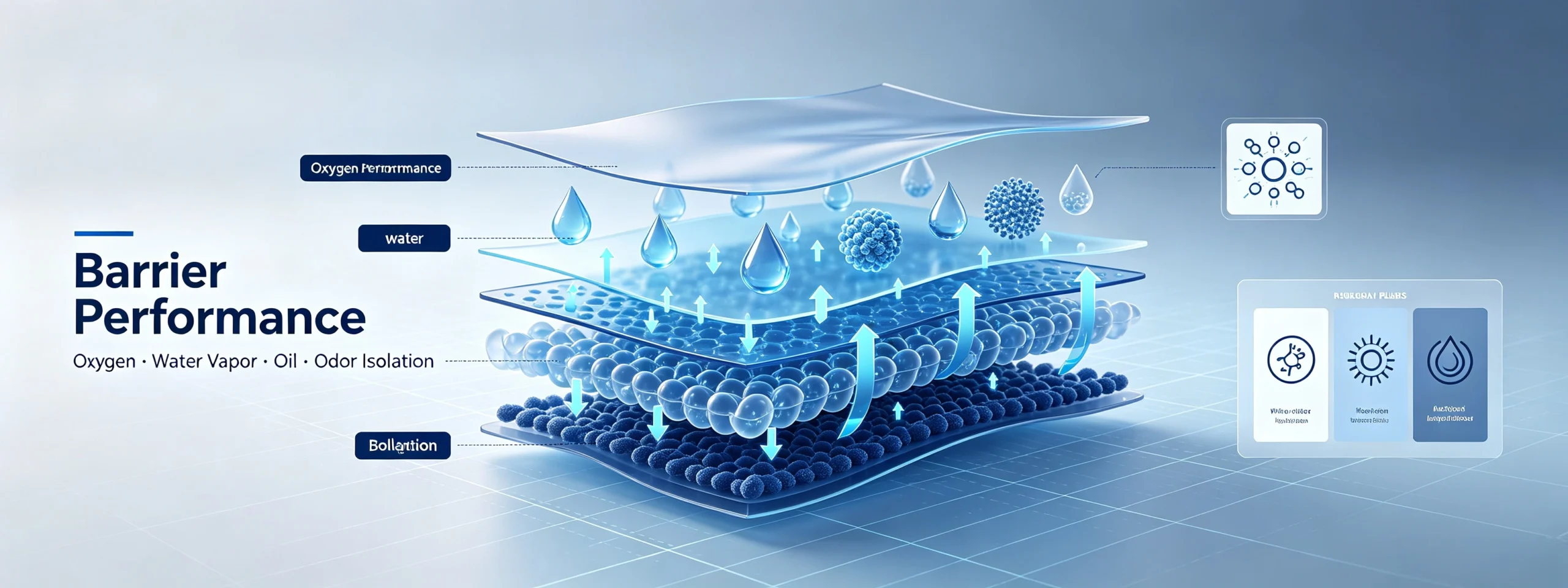
2. Barrier Performance Comparison (Shelf Life Core Index)
Barrier performance is the key factor determining food storage life, including oxygen barrier, water vapor barrier, oil resistance, and odor isolation. It is the primary selection standard for dairy packaging, cooked food packaging, and high-preservation flexible packaging.
| Barrier Index | PA Film | PP Film | PE Film | PET Film |
|---|---|---|---|---|
| Oxygen Barrier (O2TR) | Excellent, ultra-low oxygen permeability, anti-oxidation effect outstanding | Medium, ordinary oxygen barrier, suitable for short-shelf-life products | Poor, highest oxygen permeability, unable to block oxidation effectively | Superior, top-level oxygen barrier for long-term preservation |
| Water Vapor Barrier (WVTR) | Poor, easy moisture absorption, barrier performance declines after moisture absorption | Excellent, non-hygroscopic, stable moisture barrier effect | Best in four types, outstanding waterproof and moisture-proof performance | Medium-high, stable water vapor resistance, not affected by humidity slightly |
| Oil & Grease Resistance | Excellent, resistant to grease, sauce and fat corrosion, no delamination | Medium, suitable for light grease products, poor for long-term heavy grease contact | Good, stable oil resistance for daily dairy and light oil packaging | Superior, strong corrosion resistance to various grease and solvents |
| Odor Isolation & Precipitation Resistance | Good isolation, no odor precipitation, easy to absorb external peculiar smell | Excellent anti-precipitation, weak odor isolation ability | Easy odor penetration, slight plastic odor precipitation at high temperature | Best odor isolation, no precipitation, pure and safe |
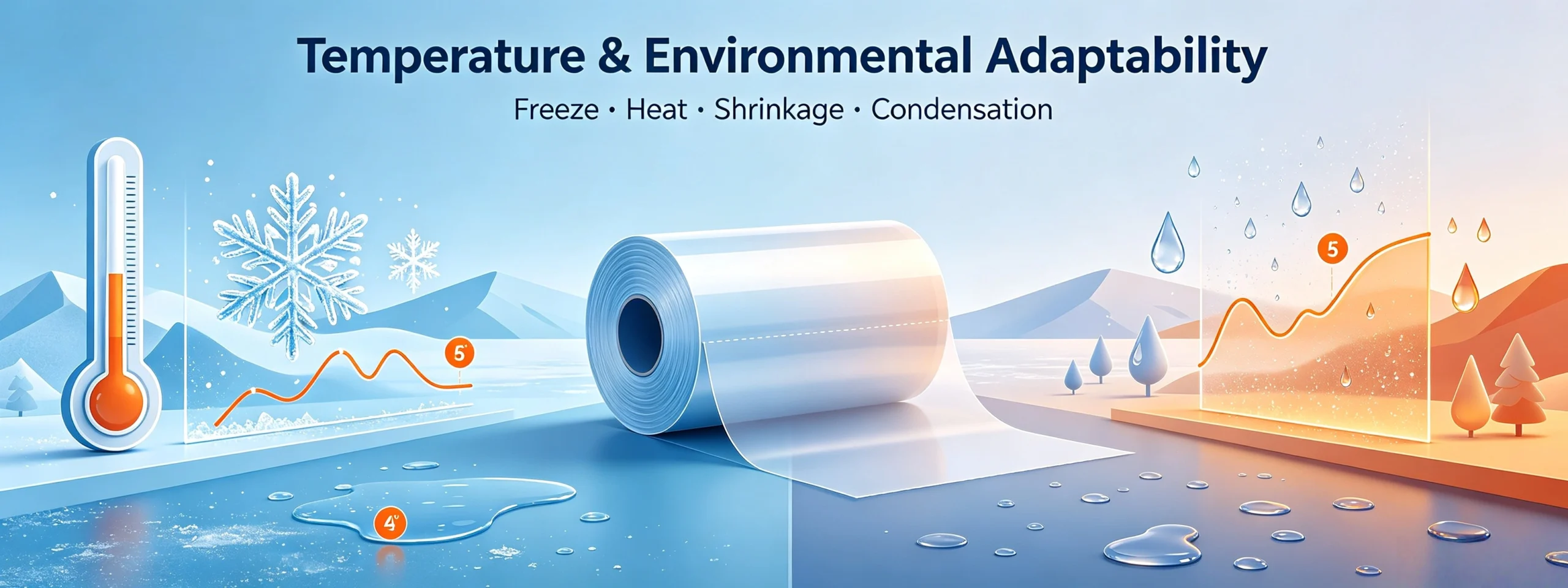
3. Temperature Resistance & Environmental Adaptability Comparison
Packaging films need to adapt to complex working conditions such as low-temperature freezing, refrigeration condensation, high-temperature heat sealing, injection molding, and temperature cycle changes. Temperature resistance directly determines the film’s yield rate in production and stability in cold chain transportation.
| Temperature & Environment Index | PA Film | PP Film | PE Film | PET Film |
|---|---|---|---|---|
| Low Temperature Resistance (-18℃~-40℃) | Excellent, no cracking or embrittlement after freeze-thaw cycles | Good, stable for conventional freezing, slight hardening at ultra-low temperature | Best, ultra-low temperature toughness, no deformation or cracking | Poor, easy embrittlement and cracking under long-term freezing and impact |
| High Temperature Resistance | Up to 120℃, support medium-temperature cooking and heat sealing | Up to 100℃, stable for conventional heat sealing and molding | Up to 80℃, easy melting and deformation at high temperature | Up to 150℃, highest heat resistance, no thermal deformation |
| Thermal Shrinkage Rate | Low shrinkage, stable size after heating | Ultra-low shrinkage, ideal for IML molding and precise printing | High shrinkage, easy wrinkling and deformation after heating | Minimal shrinkage, excellent dimensional thermal stability |
| Condensation & Humidity Resistance | Poor, moisture absorption causes performance attenuation | Excellent, non-absorbent, stable performance in humid condensation environment | Good, waterproof and moisture-proof, adapt to cold chain condensation | Good, stable performance unaffected by humid environment |
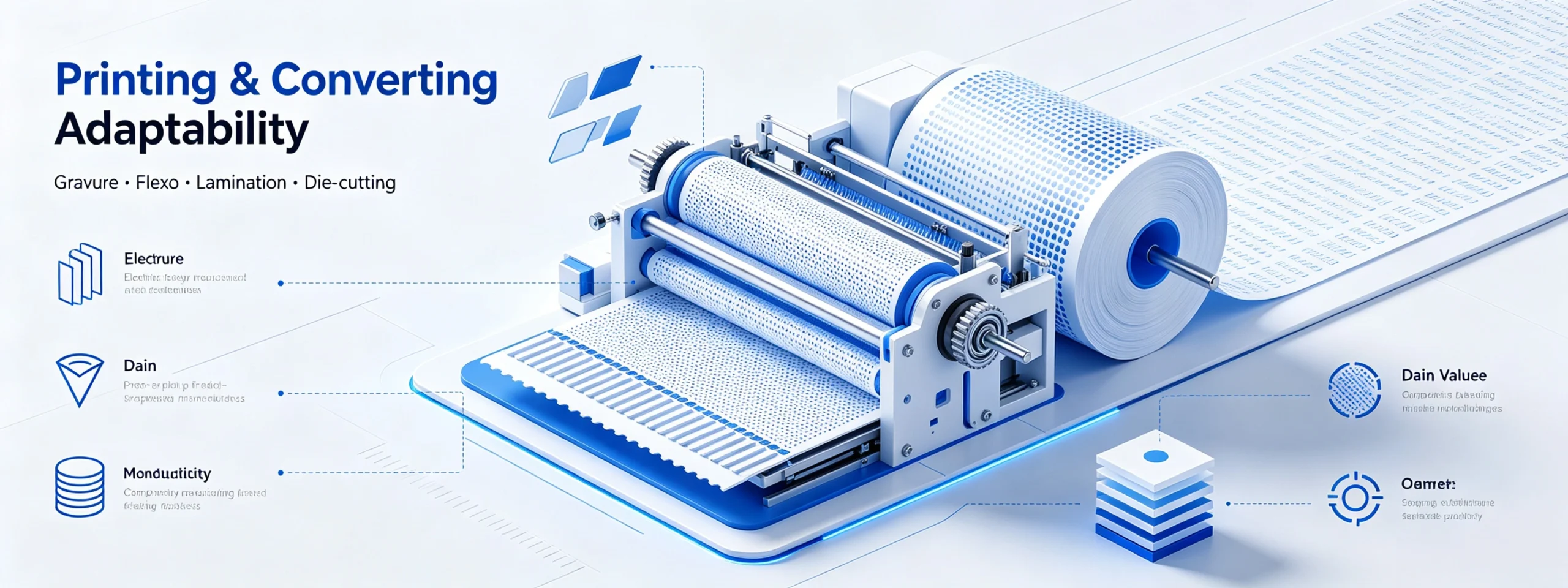
4. Printing & Converting Process Adaptability Comparison
Printing, die-cutting, lamination, and post-processing adaptability are core concerns of printing factories and converting manufacturers. Different substrates have great differences in surface tension, ink adhesion, and processing stability, which directly affect production yield and finished product appearance.
| Processing Performance | PA Film | PP Film | PE Film | PET Film |
|---|---|---|---|---|
| Surface Dyne Requirement | 40-42 dyn, stable surface tension after corona treatment | 38-40 dyn, requires strict corona treatment for printing | 36-38 dyn, low surface energy, easy ink falling off | 42-44 dyn, high surface activity, excellent printing foundation |
| Ink Adhesion Performance | Good, suitable for gravure, flexo and digital printing | Medium, prone to ink peeling if treatment is insufficient | Poor, weak ink adhesion, easy set-off and scratching | Excellent, firm ink attachment, scratch-resistant printing effect |
| Lamination Compatibility | Excellent, suitable for dry lamination and extrusion lamination | Good, stable composite effect with matched adhesive | Medium, easy delamination under high temperature and humidity | Superior, stable multi-layer composite structure |
| Die-cutting & Stacking Performance | Smooth die-cutting, neat edge, slight stacking adhesion risk | Best die-cutting stability, flat stacking, no burrs or double picking | Easy edge deformation, irregular die-cutting, serious stacking adhesion | Neat die-cutting, rigid edge, stable high-speed processing |
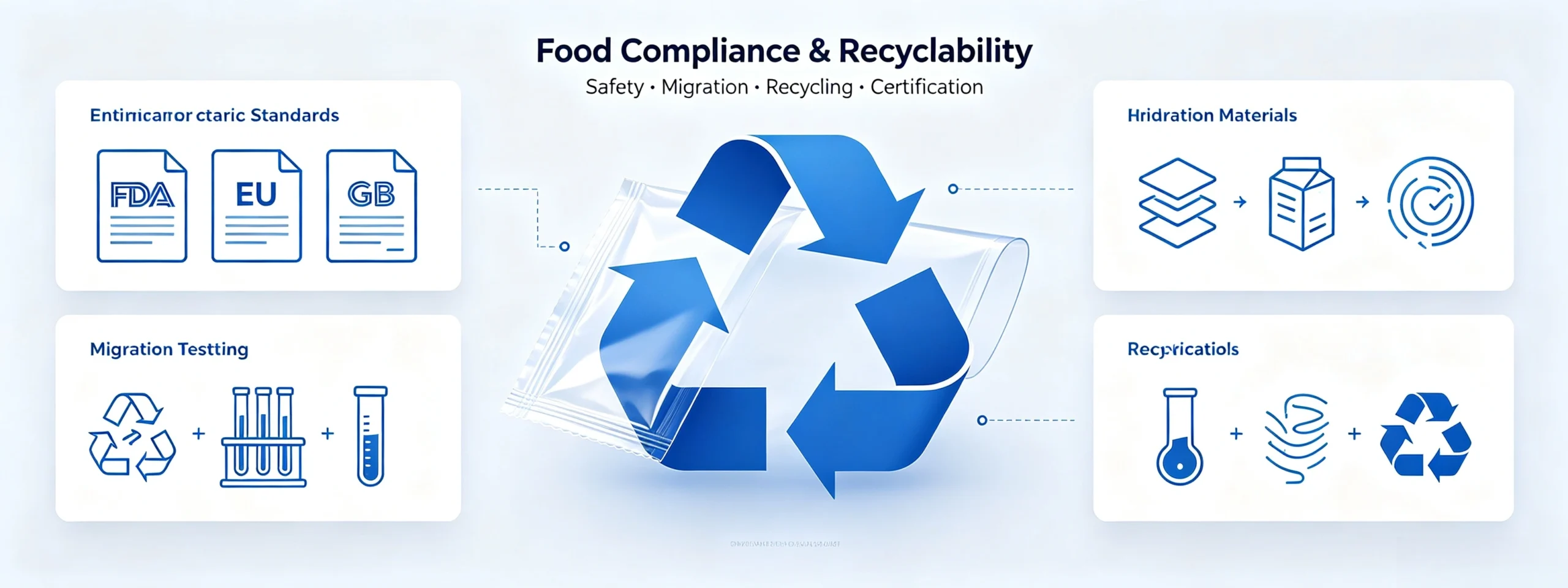
5. Food Compliance & Environmental Recycling Performance
For food and dairy packaging, food contact safety and recyclability are mandatory requirements for export and domestic sales. This dimension focuses on global certification adaptability, migration risk, and environmental protection attributes of the four substrates.
| Compliance & Environmental Index | PA Film | PP Film | PE Film | PET Film |
|---|---|---|---|---|
| FDA/EU Food Contact Compliance | Fully compliant, complete migration test certification | Fully compliant, the most mainstream food-grade substrate | Fully compliant, safe for direct food contact | Fully compliant, ultra-low precipitation risk |
| High-temperature & Grease Migration Risk | Low migration, stable in high-temperature and grease environment | Extremely low migration, safe for dairy and light oil products | Slight migration risk under long-term high temperature | No migration, highest safety for food packaging |
| Recyclability | Poor single-material recyclability, mostly used for composite structures | Excellent single-layer recyclability, environmentally friendly and easy to recycle | Good recyclability, mature recycling process | Good recyclability, widely recycled in the packaging industry |
| Degradation & Modification Potential | Difficult to degrade, limited modification space | Support biodegradable modification, strong environmental adaptability | Convenient degradable modification, low-cost environmental upgrade | Hard to degrade, single modification method |
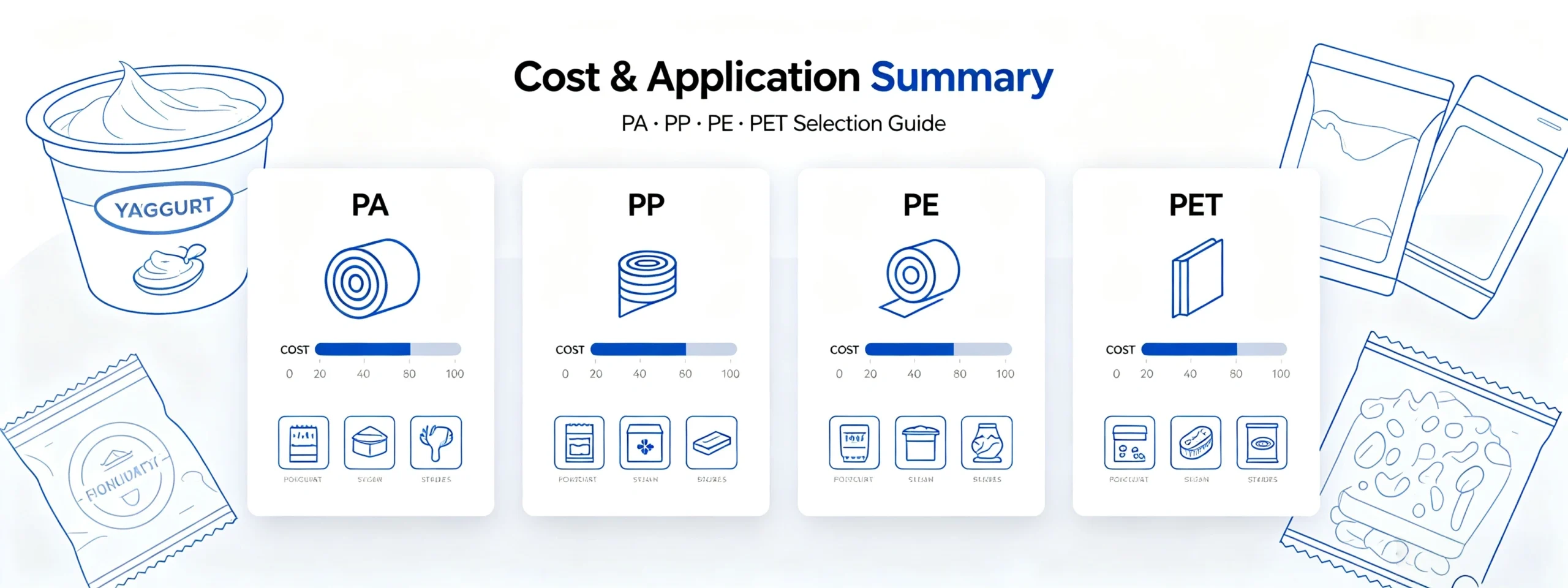
6. Cost & Applicable Scenario Comprehensive Summary
Cost performance and scenario matching are the final basis for substrate selection. The following table summarizes the cost gradient, inherent defects, and core applicable fields of the four films, helping customers quickly complete targeted selection.
| Material | Cost Level | Inherent Defects | Core Applicable Scenarios |
|---|---|---|---|
| PA Film | High | Easy moisture absorption, reduced barrier performance in humid environment, high cost | High-barrier flexible packaging, cooked food vacuum bags, puncture-resistant composite films, medium-temperature cooking packaging |
| PP Film | Medium-low | Poor low-temperature toughness, easy to crack under ultra-low temperature impact | Dairy IML in-mold labeling, yogurt cups, margarine tubs, ordinary food printing films, heat-sealing cover films |
| PE Film | Lowest | Poor oxygen barrier, low stiffness, easy deformation and wrinkling | Low-temperature frozen packaging, fresh food outer packaging, heat-sealing inner layer film, low-cost flexible packaging |
| PET Film | Medium-high | Poor low-temperature resistance, brittle and easy to crack, low elongation | High-gloss printing packaging, long-shelf-life food barrier films, high-stiffness decorative films, high-temperature resistant packaging |
Final Quick Selection Guide
- For Dairy & Cold Chain IML Packaging: Prioritize PP film, with stable flatness, condensation resistance, and food safety, perfectly matching yogurt cups and ice cream tub molding process
- For Long Shelf Life & High Barrier Requirements: Prioritize PET and PA composite structure, to achieve dual protection of oxygen and water vapor barrier
- For Low-Temperature Frozen Food Packaging: Prioritize PE and PA film, avoid PET film to prevent low-temperature embrittlement and cracking defects
- For High-Speed Printing & Die-Cutting Production: Prioritize PP and PET film, with stable dimensional stability and processing adaptability
- For Cost-Sensitive Ordinary Packaging: Prioritize PE and PP film, balance performance and production cost
If you need customized film grade recommendation, sample testing, or parameter matching for your specific packaging project, feel free to contact our professional technical team to get a targeted solution.
Message us for more information