Published: September 21, 2026 | Category: BOPP Film | Reading time: 8 minutes
Recently, we received an inquiry from a tape manufacturer in Bangladesh. The request was clear and highly specific:
“We need Tape Grade recycle BOPP Film 25, 28, 40 & 45 micron 42 dyne both side. So please update your Tape Grade recycle BOPP Film price per MT CFR Chittagong. Also confirm recycle percentage and provide sample, MSDS, TDS & GRS certificate copy.”
This is a typical and well-structured inquiry from a professional buyer. But it also raises several questions that many first-time buyers ask:
- What exactly is “tape grade” recycled BOPP film, and how does it differ from standard packaging film?
- Why do tape producers require 42 dyne on both sides?
- How is the recycle percentage confirmed, and why does it matter?
- What does CFR Chittagong mean, and what is included in the price?
- Why are GRS, MSDS and TDS documents so important?
This guide answers all of these questions in one place. If you are sourcing tape grade recycled BOPP film, this article will help you specify the right product, understand the trade terms, and avoid common mistakes.
1. What Is Tape Grade Recycled BOPP Film?
BOPP (Biaxially Oriented Polypropylene) film is the most widely used substrate for pressure-sensitive packaging tape. “Tape grade” refers to a film that has been engineered specifically for adhesive coating and slitting into tape rolls.
Compared with standard packaging BOPP film, tape grade film typically requires:
- Higher and more uniform tensile strength — so the tape does not snap during unwinding or application.
- Controlled elongation — to avoid stretching under tension.
- Consistent surface tension (dyne value) — so the adhesive and release coating bond reliably.
- Excellent thickness uniformity — to prevent coating streaks and uneven winding.
“Recycled” means the film contains a defined percentage of post-industrial recycled (PIR) or post-consumer recycled (PCR) resin. This is where the recycle percentage becomes a critical specification — and why buyers ask for it to be confirmed in writing.
👉 Related reading: Tape Grade Recycled BOPP Film: High Performance Meets Sustainability
2. Key Specifications Explained: Thickness & Dyne Value
2.1 Thickness: 25, 28, 40 & 45 Micron
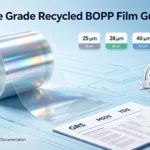
Tape grade BOPP film is commonly produced in four thicknesses. Each serves a different end use:
| Thickness | Typical Application | Key Consideration |
|---|---|---|
| 25 micron | Thin, general-purpose carton sealing tape | Cost-efficient; requires stable coating to avoid tearing |
| 28 micron | Standard packaging tape | Balanced strength and cost; most common grade |
| 40 micron | Heavy-duty sealing, industrial tape | Higher tensile strength; better for rough surfaces |
| 45 micron | Extra heavy-duty, low-temperature tape | Best puncture and stretch resistance |
When a buyer requests all four thicknesses in one inquiry, it usually means they run multiple tape product lines and want a single supplier who can deliver consistent quality across the range.
2.2 Dyne Value: Why 42 Dyne on Both Sides?
Surface tension, measured in dynes/cm, determines how well ink, adhesive and release coatings adhere to the film.
- 42 dyne is the industry-standard minimum for reliable adhesion of solvent-based and water-based adhesives.
- Both sides treated means one side accepts the adhesive (the “sticky” side) and the other side accepts the release coating (the “non-sticky” side).
- If the dyne value drops below 38, you will see adhesive failure, coating gaps, or tape that does not unwind smoothly.
For tape grade film, a stable 42 dyne on both sides — maintained over the full roll length and shelf life — is a non-negotiable quality requirement.
3. Recycle Percentage: What It Means and How to Confirm It
When a buyer asks to “confirm recycle percentage,” they are not asking for a verbal estimate. They need a documented, traceable figure.
Recycle percentage is usually expressed in one of two ways:
- Pre-consumer recycled content (PIR): Production waste reclaimed within the film manufacturing process.
- Post-consumer recycled content (PCR): Material recovered after consumer use.
In practice, most tape grade recycled BOPP film on the market contains 30% to 50% recycled content. The exact figure must be stated on the TDS and supported by the GRS certificate.
Important: Higher recycled content can slightly reduce clarity and tensile strength. A reputable supplier will tell you the trade-off and recommend the right grade for your tape application, rather than simply quoting the highest possible percentage.
4. CFR Chittagong: What the Price Includes
The inquiry asks for a price per MT CFR Chittagong. This is a common and clear Incoterms request from buyers in Bangladesh.
| Item | Included in CFR Price? |
|---|---|
| Film cost (per MT) | ✅ Yes |
| Export packing | ✅ Yes |
| Inland transport to port of loading | ✅ Yes |
| Ocean freight to Chittagong | ✅ Yes |
| Marine insurance | ❌ No (that would be CIF) |
| Import customs duty & clearance at Chittagong | ❌ No (buyer’s account) |
| Port charges at destination | ❌ No (buyer’s account) |
When quoting CFR Chittagong, always state the port of loading, the currency, the payment terms, and the validity period of the quotation. For Bangladesh, buyers also frequently ask about HS code, country of origin, and whether the supplier has experience with Chittagong port congestion — all of which affect lead time.
5. Documentation: GRS, MSDS and TDS
The inquiry requests three documents along with the sample. Each serves a distinct purpose.
5.1 GRS Certificate (Global Recycled Standard)
The GRS is an international, voluntary standard that verifies recycled content and tracks it through the supply chain. For tape grade recycled BOPP film, a valid GRS certificate:
- Confirms the declared recycle percentage is independently verified.
- Allows the buyer to make verified recycled-content claims to their own customers.
- Is increasingly required by brand owners and retailers in Europe and North America.
Always ask for the certificate number and verify it with the issuing body (e.g., Control Union, Intertek). A copy of the certificate alone is not enough — the scope must cover the specific film grade you are buying.
5.2 MSDS (Material Safety Data Sheet)
The MSDS covers handling, storage, transport and safety information. It is required by many customs authorities and by the buyer’s internal EHS team. For BOPP film, it is a short but mandatory document.
5.3 TDS (Technical Data Sheet)
The TDS is the most important document for the buyer’s technical team. It should list:
- Thickness and tolerance
- Density and yield (m²/kg)
- Tensile strength (MD/TD)
- Elongation at break (MD/TD)
- Surface tension (dyne value, both sides)
- Recycle percentage
- Heat shrinkage
- Roll width, core size and roll length
If a supplier cannot provide a detailed TDS, that is a red flag. You cannot run a stable tape coating line on a film specification that is not documented.
6. Sample, MOQ and Lead Time
Before placing a bulk order, always request a sample roll for trial coating. A professional supplier will provide:
- A sample of each thickness you are evaluating (25, 28, 40, 45 micron).
- The corresponding TDS and MSDS.
- The GRS certificate copy.
- A clear statement of MOQ per thickness and per order.
Typical lead times for recycled BOPP film are 2–4 weeks after order confirmation, plus ocean transit time to Chittagong (usually 2–3 weeks from major Chinese ports). Always build buffer time into your production planning.
7. How to Choose a Reliable Supplier
Based on inquiries like the one above, here is a short checklist for evaluating any tape grade recycled BOPP film supplier:
- Can they confirm recycle percentage in writing? Verbal claims are not enough.
- Do they hold a valid GRS certificate? Verify the certificate number independently.
- Can they guarantee 42 dyne both sides over the full roll? Ask for test reports.
- Do they offer all four thicknesses (25/28/40/45 micron)? A single-source supplier reduces complexity.
- Do they have experience exporting to your destination? Chittagong, for example, has specific port and documentation requirements.
- Are TDS and MSDS available before the sample arrives? This shows technical discipline.
8. Conclusion
A well-written inquiry — like the one quoted at the top of this article — tells the supplier exactly what the buyer needs. If you are sourcing tape grade recycled BOPP film in 25, 28, 40 or 45 micron with 42 dyne on both sides, and you need CFR Chittagong pricing along with GRS, MSDS and TDS documentation, you are not asking for anything unusual. You are asking for a standard, professional supply.
What matters is choosing a supplier who can confirm every one of those points in writing, provide samples for trial, and deliver consistent quality across all four thicknesses.
Ready to source tape grade recycled BOPP film?
Send us your target thickness, dyne value, recycle percentage and destination port. We will reply within 24 hours with a detailed quotation, TDS, MSDS and GRS certificate copy.