Why Does BOPA Laminated Film Wrinkle in High‑Speed Lamination? Causes & Practical Solutions
1. Introduction: The Typical High-Speed Wrinkle Problem
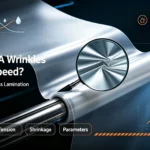
Many flexible packaging converters face a confusing and costly issue: BOPA lamination runs perfectly at low speed but produces obvious wrinkles once the line speed increases. These wrinkles appear as edge waves, linear creases, or irregular surface undulations, ruining print register, sealing flatness, and final pouch appearance. Worse, they lead to mass rejection, machine downtime, and unstable batch quality.
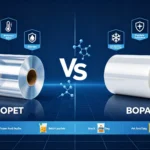
Unlike BOPET and PP films, BOPA (nylon) film is highly sensitive to humidity, tension fluctuation, and thermal shrinkage. At high lamination speeds, minor parameter mismatches that are negligible at low speed will be amplified into visible wrinkles.
In this article, we break down four core causes of high-speed BOPA lamination wrinkling and provide actionable, factory-verified solutions for both solvent-based and solventless lamination lines.
2. Core Cause 1: BOPA Film Hygroscopic Deformation & Unstable Tension
BOPA nylon film easily absorbs moisture from the air, especially in high-humidity tropical and subtropical workshops. Moisture softens the film surface and changes its tensile elasticity.
At low speeds, the film has enough time to stabilize and release internal stress. However, during high-speed lamination:
- Moisture-swollen BOPA stretches unevenly under fast web movement
- Unwinding tension cannot follow rapid speed changes, causing local looseness or over-stretching
- After lamination, the damp BOPA gradually shrinks during curing, forming wavy wrinkles
Practical Solutions:
- Control workshop humidity below 60% RH; equip dehumidifiers in rainy seasons
- Set matched BOPA unwinding tension: 60–90N for standard 12μm BOPA full-width production
- Avoid over-tensioning BOPA at high speed, which leads to post-curl and wrinkling
- Use moisture-proof film storage and vacuum packaging for unused BOPA rolls
3. Core Cause 2: Mismatched Lamination Speed, Temperature & Drying Gradient
High-speed lamination greatly shortens the film’s residence time in the drying tunnel and heating zone. Improper temperature settings are one of the most common hidden causes of wrinkles.
Common field mistakes:
- Temperature too low: Adhesive cannot fully wet out; residual solvent creates micro slippage between layers, causing wave wrinkles
- Temperature too high or uneven: BOPA produces uneven thermal shrinkage; temperature difference over 15℃ across rollers will induce local deformation
- Speed increases without adjusting tunnel temperature curve, leading to incomplete drying and unstable bonding
Practical Solutions:
- Optimize the 3-stage drying temperature curve according to line speed upgrade
- Ensure roller temperature difference within ±10℃ for uniform heating
- Increase oven temperature moderately while raising speed to guarantee full solvent evaporation
- For solventless lamination, extend pre-heating time to eliminate BOPA internal stress before high-speed running
4. Core Cause 3: Mechanical & Roller System Abnormalities
Mechanical defects that do not affect low-speed production will be fully exposed at high speed. Unparallel rollers, uneven pressure, and dirty roller surfaces directly cause BOPA feeding deviation and wrinkling.
Key mechanical issues:
- Pressure roller pressure uneven: one side tight, one side loose, resulting in edge wrinkles
- Guide roller abrasion, dirt, or eccentricity causing unstable web transmission
- Misaligned roller parallelism leading to diagonal creases
- Poor tension sensor sensitivity, failing to respond to fast speed variation
Practical Solutions:
- Calibrate roller parallelism and pressure balance weekly
- Clean roller surface glue residue and dust regularly to ensure flat contact
- Replace worn guide rollers and update tension control sensors for high-speed adaptation
- Install spreader rollers to eliminate edge tension accumulation
5. Core Cause 4: Adhesive Coating & Rewinding Mismatch
High-speed lamination requires matched glue coating weight and rewinding parameters. Excessively thick or uneven adhesive layers cannot level out in a short time, causing internal layer slippage and surface wrinkles.
Typical coating problems:
- Over-high coating weight leads to residual solvent and slow curing
- Uneven glue distribution causes inconsistent bonding strength across the web
- Improper rewinding tension: too tight at core and too loose at outer layers
Practical Solutions:
- Adjust coating weight according to speed upgrade to ensure uniform adhesive coverage
- Optimize glue dilution ratio and stirring time to avoid bubble generation
- Adopt taper rewinding tension to keep flat roll appearance after high-speed lamination
- Set proper curing temperature and time to release BOPA internal stress completely
6. Quick On-Site Troubleshooting Checklist (For Engineers)
Use this checklist to quickly locate high-speed BOPA wrinkle causes during production:
- Check workshop humidity & BOPA moisture absorption status
- Verify BOPA unwinding tension matches film thickness and speed
- Inspect roller parallelism, surface cleanliness and pressure uniformity
- Confirm drying tunnel temperature gradient matches current line speed
- Test adhesive coating uniformity and solvent evaporation effect
- Adjust rewinding taper tension and curing parameters
7. Final Conclusion
BOPA high-speed lamination wrinkling is not a single-factor defect but a combination of BOPA’s hygroscopic characteristics, parameter mismatch, mechanical deviation, and coating instability. The key to solving the problem is understanding that BOPA is far more sensitive to speed and environment than other packaging films.
Stable high-speed production relies on standardized humidity control, tension parameter matching, regular mechanical calibration, and optimized thermal curing processes.
8. Get Professional BOPA Lamination Technical Support
If you are still facing unstable BOPA wrinkling defects after parameter adjustment, our technical team can provide free film evaluation, parameter optimization suggestions, and customized BOPA film grade selection for your high-speed lamination line.
Send us your production speed, workshop environment, and lamination process details, and we will help you eliminate defects and improve yield rate.
Message us for more information